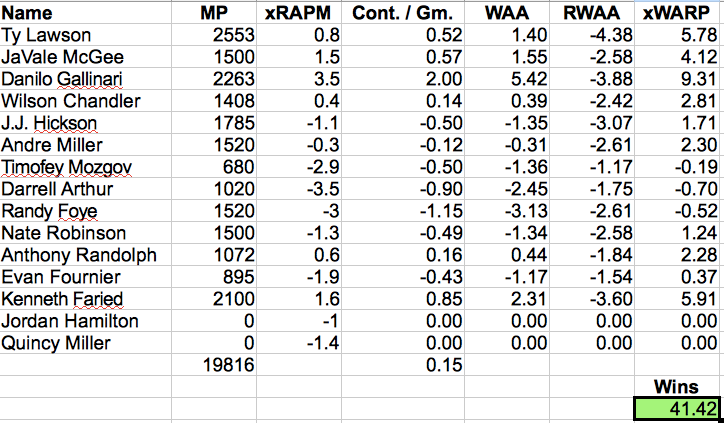
The Denver Nuggets had a no good, very bad offseason. They lost their very talented GM and fired their very good coach. They lost their best wing defender, and arguably their best overall player, to the team that ousted them from the postseason. They lost a couple other helpful players like Kosta Koufos and Corey Brewer. They added a number of players who simply shouldn’t be expected to be very helpful- like Randy Foye, Darell Arthur, and to a lesser extent, J.J. Hickson. How does it all add up?
After adjusting for the league-wide context (subtracting 1.112 from the .15 net rating shown above), the Nuggets total Net Rating is roughly -.96. That translates to a 38 win squad. Given that they have the strongest homecourt advantage in the league and the schedule they actually will play, the Nuggs project to be a 40 win team. Regardless of whether the first or the latter number proves to be more correct, the Nuggets appear to be in line for a staggering fall from their 57 win record of last year. The takeaway is that losing Andre Iguodala, Kosta Koufos, and Corey Brewer and replacing them with much worse players is going to really hurt the Nuggets this year. It should not shock anyone at all to see them fall all the way out of the playoffs. Hopefully for Denver’s fans they have a plan going forward to right the ship that’s seemingly lost its way.
The Toronto Raptors had a great offseason. First, and probably most important for the longterm, they hired Masai Ujiri as their new GM. Ujiri has developed quite a reputation for being one of the league’s finest executives. As is often the case with what seem like great GMs, though, he’s made a lot his hay thus far by duping the New York Knicks into dumb trades.
First, the Knicks gave up a whole host of useful players- Danilo Gallinari, Raymond Felton, Wilson Chandler, and Timofey Mosgov –and a 2014 first round pick all to get Carmelo a few months earlier than they could have gotten him in free agency. That was all our man Masai.
Then, in the Raptors second great move of this summer, in his first few days as the new man at the wheel in T-Dot, Ujiri unloaded Andrea Bargnani’s albatross of a contract and convinced the Knicks to include a first round pick and a couple of second rounders with deadeye shooter Steve Novak and Marcus Camby’s contract, all for the right to be the team that eats the remainder of Bargnani’s turd sandwich of a contract. Gotta hand it to Masai, he knows which teams to call when it’s fleecing time. Usually, that means the Knicks- and Knick fans thought this would end when Isaiah was fired. Ha! What’s the result of all the Raptors maneuvering, according the Walker xRAPM projections and my minutes allocation and context adjustment?
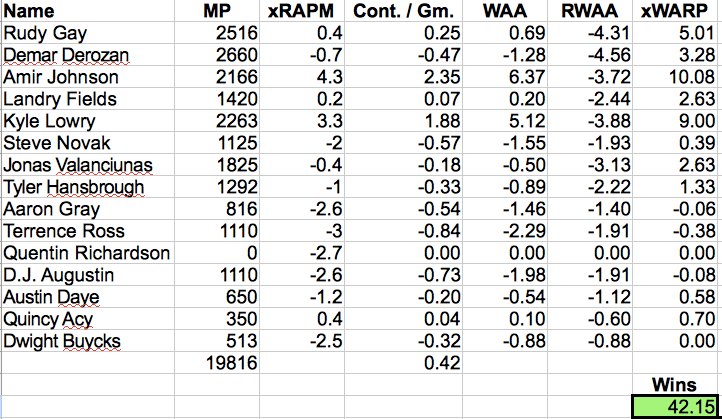
Pretty good, Raps fans. Pretty, pretty good. The Raptors project to be just very slightly better than the new-look Pistons, but they both project to win 39 games- after adjusting the win totals so that they properly sum to 1230 leaguewide or, more accurately, so that total xRAPM sums to 0, as it must by definition. The Raps and Pistons project to finish 7th and 8th, respectively, in the East. Right on their heels should be Cleveland and Washington- though I projected Washington prior to the news of Emeka Okafor’s indefinite absence due to a neck injury, so maybe they’ll be out of the running, as he was one of their stronger expected xRAPM contributors. Looking at the injuries Washington has already suffered and the relatively injury prone Cleveland roster, I’d say that if I had to bet on it things, the Raptors and Pistons seem to be by far the best bets of these 4 teams to snag those last two playoff spots.
How do the Raptors look to get it done? Well, they’ve got a strong starting five lead by the unheralded, but dynamic xRAPM combo of Amir Johnson and Kyle Lowry, who both project to be very, very good players. Rudy Gay projects to be slightly above average, as ever. Jonas Valanciunas projects to improve significantly, getting him close to average level xRAPM, at a very young age — which bodes well for his future. Landry Fields is also around, looking likely to be very average overall and remaining laughably overpaid for that very average play. I hope he’s sending a portion of those checks to a charity of Steve Nash’s choosing. DeMar DeRozan will help and he’ll excite with his flashy play, but he still projects to be a bit below average and he’ll probably never live up to his own rather large contract. It’ll be interesting to see if Masai Ujiri attempts to move either of those last two. Even if Ujiri makes no moves, though, this current Raptors roster has a very good chance at playing games in late April. Rejoice, Raptors fans!
The Minnesota Timberwolves haven’t made the playoffs in nine seasons. They’ve likely had the talent to make it over the last two years, but bad luck with injuries to their two most important players, Kevin Love and Ricky Rubio, have, unfortunately, blown those hopes to hell. Love and Rubio have combined to play just 171 games of 296 games the two of them, together, could have possibly played over the last twoyears. Next year, as it always does, provides another opportunity for the ‘Wolves to crack the playoffs for the first time in ten seasons. What do the numbers suggest Minnesota fans can likely expect?
This ‘Wolves squad has 45 win talent, without context. On the other hand, the numbers, as I ran them initially, gave each team, on average, 1.11 points over the required sum of 0 total net points across the league- given that basketball is a zero sum game. Every player making a positive contribution comes, in +/- and thus xRAPM, at the expense of another player or set of players being debited for those positive contributions coming against them. As a result, you can adjust the strength of each team simply by subtracting out those 1.12 points from their total Contribution per Game. When it doing this with the Timberwolves, it makes them a +.31 team. Plugging in to the simple MOV to wins equation (2.7*MOV+41 = Wins), the Timberwolves project as a 42 win team. This jives with their projection in the big schedule spreadsheet, as a 42 win team, when factoring in their strength, the strength of their opponents, and their home court advantage.
How does Minnesota get there? Kevin Love and Ricky Rubio carry most of the weight, as any even casual Timberwolves observer would expect. Their health is, obviously, of paramount importance for the ‘Wolves to reach their postseason goal. Nikola Pekovic, Kevin Martin, Chase Budinger, Corey Brewer, and Derrick Williams are the lesser lights ranging from slightly above average to slightly below, though, they’re all solidly above replacement and so they should all be helping. Also of note, Shabazz Muhammad projects to be pretty okay as a rookie, by the Hickory High rookie projections, and as a result, he’s an above replacement contributor by these numbers.
For my part, I’ll be rooting for the ‘Wolves. Their fans have dealt with the disappointment of David Kahn’s draft record, the tantalizing frustration of waiting for Ricky Rubio to come over from Spain, and the scuttling of the last two promising seasons due to Love’s recurring injuries and Rubio’s torn ACL. The players, Love especially, must be just as frustrated, if not more so. This is a team that, health permitting, should compete for the right to test themselves against the Thunder or the Rockets or the Clippers in the first round of next seasons’ playoffs. Hopefully the Timberwolves will finally be playing come late April.
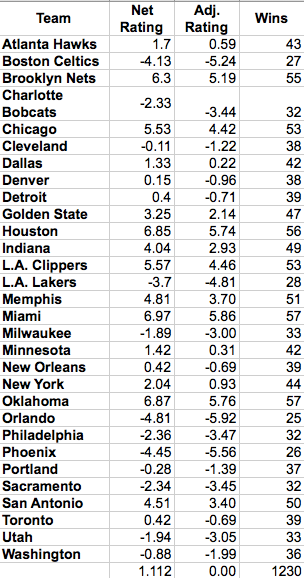
I mentioned before that my initial run through of the projected wins for each team overestimated wins, due to the xRAPM projections combined with my minutes projections projecting league average xRAPM to be +1.11 per game, which is impossible. The average total xRAPM per team across the league must, by definition, equal zero. Any team’s positive xRAPM- because it is a plus-minus statistic- comes at the expense of its opponents’ xRAPM, so across the 30 teams, things must sum to 0. In order to account for this, I adjusted the net rating of each team to reflect the +1.11 initial average and reset the league average to 0. This also results in team wins summing properly to the 1230 available in any given year. Below is a chart with the adjusted net ratings and win totals. After that, those win totals are placed into the context of each conference, so you can see which teams project to be in the playoffs.
I think these results pass the smell test, with the notable exception of Philadelphia inexplicably projecting to win 32 games. Let me know what you think. I’ll be continuing to post team breakdowns, with the unadjusted numbers (all of my graphics showing the numbers are already done and it would be a pain to redo them all), though I’ll be sure to make note of the need to adjust the numbers to account for the +1.11 average in those future posts.
I’ve addressed the biggest problem with the xWARP projections by doing my exhaustive look at each team’s schedule using probability to project an expected number of wins. As a result, all of the projected wins data is already out there for you to look through, but I enjoy writing about each team and, I think, people like to read these looks at each team through Nathan Walker’s projected xRAPM. Plus, in writing about each team’s makeup, it’ll be more apparent how I arrived at the relative predicted strength of each team. This was represented as “Net Rating” in the big spreadsheet, but on the team posts, its the summation of Contribution per Game (“Cont. / Gm.” in the charts). I still think this is a useful exercise, so I’m going to continue doing it. Today, I’ll be taking a look at a team many people have pegged for an Eastern Conference playoff spot, the Washington Wizards.
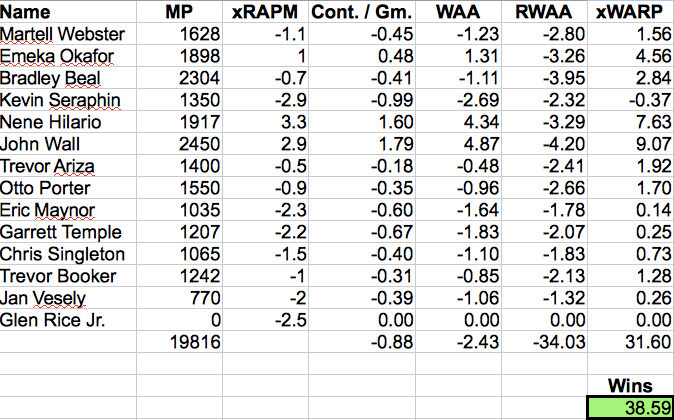
The Wizards look pretty much as expected, at first blush. They’ve got a Net Rating or Total Cont. / Gm. of -.88 which makes them roughly a 39 win team, all else equal. All else is, however, not equal. It never is in the NBA. Strength of schedule does matter somewhat, especially for teams on the cusp of a playoff spot. The Wizards projected win total using the log5 method with the net ratings of their opponents projects them to win only 37 games. 2 wins may not seem like a lot, but, again, it matters a great deal for teams jockeying for those final couple playoff spots in each Conference.
John Wall projects to be quite good, by the projected xRAPM numbers, basically repeating his performance from last year, only with more minutes played. If Wall can actually make a leap ahead of his performance last year, the Wizards will more firmly entrench themselves as a playoff team. Two of Washington’s more important players, Nene and Emeka Okafor, both project to either regress and/or decline, with Nene having the bigger expected dropoff. These declines somewhat offset the expected increase in minutes for Wall, and here we are. The Wizards may find themselves on the outside looking in on the playoffs, again.
Subjectively, my initial thought was that Bradley Beal will prove to be much better than his projected xRAPM suggests, and with Wall’s potential for improvement, this 37 win projection may prove much too low. Beal is so young and the talent is so clearly there that it’s hard to believe he won’t be a better than league average player next year by xRAPM. On the other hand, Beal’s xRAPM last year was -2.0, owing mostly to subpar defense, so a -.7 total xRAPM would represent a pretty large improvement, on its own. Maybe Nathan Walker’s on to something with his numbers. In any event, the statistical projection game is fraught with caveats galore, so as always, take these pieces for what they are: a fun exercise in educated guessing at what next year’s season holds.
Following up on my last post, I decided to leap ahead a bit and use the projected season level team point differentials and home court advantage numbers from Evan Zamir — which show that not all home court advantages are made equal — in order to predict the probabilities of a team winning each game on its schedule, based on the strength of the opponent and whether the game was home or away. The above spreadsheet is the result of all that work. The column marked “Log5 W%” represents the probability a team will win a given game, using the log5 method. The column marked “Pyth W%” is the same, only using the projected point differential-marked “Game MOV” in the spreadsheet- in order to use the Pythagorean formula to determine the probability of a win in that game.
Caveats, of course, abound. The minutes projections that I made could be wrong, skewing the projected strength of each team. The xRAPM projections from Nathan Walker and the rookie projections from Hickory High will be imperfect- they are just projections, afterall. In addition, teams may play better or worse for a stretch than their season level strength might indicate- for example, the Lakers will likely be much worse in the early part of their schedule when they are likely to be without Kobe, despite all of his tireless work to get back in time for the start of the season. Kobe is Kobe, but Kobe is also human and a torn achilles is one of the toughest injuries from which to return that exists. So take these numbers with the large dose of salt that they deserve. But, you know, have fun with them.
Sidenote: the Sixers will almost certainly not win 33 games or anywhere close to that many- I’m not sure what to do about that. The issue, I think, is that xRAPM basically measures impact on the court- but within the role that the player played- and can’t really account for changing roles. A lot of players on Philadelphia’s roster are going to be thrust into roles for which they are simply ill-equipped, whether due to inexperience or lack of talent, and therefore, I’d be shocked if you saw them perform at the level they are projected to perform by the numbers. This includes their new rookies, Nerlens Noel and Michael Carter Williams, who both project to be solid rookies, according to the Hickory High regression. Those projections are based on a regression of past performers and I think it’s pretty fair to say that the average rookie in the time frame during which the regression covered simply did not have anywhere near the level of free reign- and therefore on-court responsibility — that Noel and MCW will have this coming season.
In calculating the xWARP projections I’ve been doing, I noticed a worrying problem. The total number of wins projected for each team appeared to be roughly 7% too high. There are only 1230 games, and thus, 1230 wins available for the 30 teams in the NBA to win. In doing my xWARP projections, I had just been posting the win totals as I did each team.
Last night, I finally got around to running the numbers on all of the remaining teams I’d yet to post and summed up team wins for the whole league. Unfortunately, total team wins summed to roughly 1318 wins, which is obviously way too many. There are a number of ways to deal with this problem. The lazy, easy way would be to simply multiply the win totals of each team by 1230/1318 or roughly .933. The top teams then have 55 projected wins and the bottom dwellers would be in the mid to high 20s in wins. This solves the problem, but it doesn’t seem that consistent with reality, so I’ve decided to go another way.
I’ve hinted at wanting to do this before, but my current plan is to go through each and every game on the schedule and utilizing the projected MOV for each team (in the spreadsheets it’s the total Contribution / Game) plus Evan Zamir’s ridge regression work on homecourt advantage, I plan to figure out the win probabilities of each of the 1230 regular season games and then use those probabilities to determine total team win totals. I will then post the updated results. I will be updating the posts that already exist to reflect changes in team win totals after this is all done, and I will also do a master post with the full league projections.
I’m bummed out that the math didn’t work out as well as I’d hoped, but I’m excited to go through the schedule in such detail. The other good thing is that doing things this way acts as a built in strength of schedule adjustment for teams with more or less difficult schedules. Thanks for reading and for your patience while I work out the kinks of all this.
My work projecting the NBA using xRAPM has lead to some interesting conversations with readers and other interested NBA fans. It also lead to further discussion with Nathan Walker over of The Basketball Distribution, who was the person who inspired me to start doing these projections in the first place. Through an e-mail exchange, he provided me with a method, using the age and prior year xRAPM of the player in question, which projects xRAPM for the next year very well. The R² is .74. Given that this method seems much more scientific and how startlingly good the results are at predicting future performance based on such simple inputs, I will be re-running my projections for the 8 teams that I’ve already done and then continuing on using the method Nathan provided going forward. The minutes projections will still be done using the Kupfer method described previously here. I plan to try to bang out the remainder of the projections within the next few weeks and then adjust based on strength of schedule and HCA at the end of the process and right before the season gets underway to try and have the best possible projections for you. Basically, we’ve got a brand new recipe and it’s time to get cookin’.
Oh and go follow Nathan on Twitter, since he’s awesome and helped me do a better job than what I was doing.
The Cavs have reportedly signed Andrew Bynum, the much maligned center formerly of the Los Angeles Lakers and the Philadelphia 76ers… sort of. Bynum never actually played a minute for the Sixers, spending much of the year alternating between being injured and angering the good people of Philadelphia by bowling, despite his fragile knees, suffering a setback in his knee rehab in the process.
Going into the offseason, there was a lot of curiosity over what would be the market for Bynum’s services. The Sixers quickly took themselves out of that market, through their draft day acquisition of Nerlens Noel and a top-3 protected 2014 first round pick in exchange for All-Star point guard, Jrue Holiday. With that maneuver, Sixers’ GM Sam Hinkie signaled that he was committing to a rebuilding season and that Nerlens Noel would be his center of the future.
It quickly became clear that only three teams were really pursuing Bynum- the Cleveland Cavaliers, the Atlanta Hawks, and the Dallas Mavericks. As it turned out, the market for Bynum was pretty dry. The Cavaliers made the best offer, and from Bynum’s perspective, it’s not even that great an offer. Bynum’s deal will potentially pay him $12 million per season for 2 seasons, but he has to reach performance incentives, including a minimum numbers of games played in the first season. The second season is a team option. All told, Bynum is only guaranteed $6 million in this deal. This is basically a no brainer for the Cavaliers. The contract incentives Bynum must reach to get his money provide him a reason to care, to show up, and to not spend his time bowling instead of rehabbing. An engaged Andrew Bynum is a very, very good player. He’s arguably the second best center in the league, behind only Dwight Howard, when he’s on it. The trouble is his health and his attitude. This deal protects the Cavaliers from both of those potential downsides.
As far as things on the court go, the Cavs have built a neat team around star point guard, Kyrie Irving. They have a floor stretching power forward in the recently drafted Anthony Bennett. They have two very good big men, when healthy, in Anderson Varejao and now Bynum. They have backcourt scoring in bunches in Irving and promising shooting guard, Dion Waiters. Additionally, they added veteran guard and third place finisher for this year’s Sixth Man of the Year, Jarrett Jack. On the wing, they signed Earl Clark, who could intrigue if he builds off of a solid season of improvement last year. Head coach Mike Brown will get this group to defend better than last year, and now with Bynum, Brown has a very good rim protector to pair with Varejao’s active all-around defensive efforts. This is a team that should compete for a playoff spot, if things go right. Bynum will have a lot to say about that. Here’s hoping he takes advantage of this opportunity and reminds everyone of how good he can be when he’s right mentally and physically.
The New Orleans Hornets Pelicans got their man on Thursday by completing a three team trade with the Sacramento Kings and Portland Trailblazers. The Pelicans agreed to pay Tyreke Evans $44 million over 4 years, the Kings received combo guard Greivis Vasquez from the Pelicans to help facilitate the sign and trade plus a second round pick from the Blazers, and the Blazers got center Robin Lopez in exchange for the newly drafted, Jeff Withey.
Evans is a player who showed enormous promise in his first year, winning the rookie of the year award, dropping a very good (for a rookie) 18+ Player Efficiency Rating. The problem for Evans, and now for the Pelicans, is that Evans hasn’t gotten any better, really, since that rookie season. He got worse for two years following his rookie year before bouncing back this year where he was marginally better than his rookie year. Players this young and this talented shouldn’t stagnate for 3 full years but that is just what Evans has done. This deal feels like it could be a pretty big overpay, but Tyreke Evans has consistently shown the rare ability to get wherever he pleases on the basketball court, along with solid passing and rebounding for a wing player. He’s still a below average shooter and his defense is poor. If his shooting continues to improve, as it did this year, and if he can figure things out defensively, this will seem like a good, maybe even great deal. Looking at it without the benefit of knowing the future, it feels like a reach. The Pelicans are betting on Evans’s talent and their own coaching staff’s ability to get the most out of him, and it’s hard to totally blame them. After his first year in the league, Evans looked like a sure bet to be a candidate for a maximum contract extension. If he lives up to that promise in New Orleans, this deal will go from looking like a reach to an absolute steal. That’s the way these things go sometimes. Just ask people who bashed Mike Conley’s extension or questioned the Warriors for locking up Stephen Curry when concerns about his weak ankles were rampant. Conley now seems appropriately paid and Curry is, rightly, perceived to be an absolutely incredible value as a borderline superstar level player working on a contract several million a year below the maximum he could be paid. Evans will be just 24 next season and if you’re going to risk overpaying a player based on projected growth, betting on a player who will be just 24 in the first year of a 4 year deal is one of the best bets you can make, especially when it is already clear, as is the case with Tyreke, that the talent is there.
The Kings, under newer, much more competent management, have done well for themselves here. Once it became clear that New Orleans was going to pay much more for Evans than his production the last few years would suggest is wise, and the Kings knew they were uncomfortable making the bet that Evans lives up to his potential, getting assets in return for losing him became paramount. That’s just what the Kings have managed. Greivis Vasquez is a solid offensive player, who doesn’t really have the physical tools to be a plus defender. Vasquez has improved every year he’s been in the league and stands to make just a bit over $2 million next year. He’s a nice value to go with the second round pick the Kings picked up in the deal from the Blazers.
The Blazers got Robin Lopez as a defensively focused center to pair with their star power forward LaMarcus Aldridge. Lopez is also an efficient scorer on an average usage level, so he is not a negative on the offensive end by any means. He should be a very good fit with Aldridge, and the Blazers must hope his presence will help convince LMA to stop demanding trades to my beloved Bulls.




 nbacouchside.net