Building Around Jimmy: What Should the Bulls Do Moving Forward?

Ideas for team-building around Chicago’s newest superstar

Still the franchise.

In my last post, I outlined the ways in which the Chicago Bulls front office has failed to surround their best player, Jimmy Butler, with complimentary talents. In this post, I’ll toss off some ideas, most of which seem at least theoretically plausible, for the Chicago front office moving forward.

Trades

If I were running the Bulls, I’d be trying to flip Taj Gibson for some kind of guard or wing who can shoot. The return for Gibson needn’t be incredible, as he’s 31 years old and unlikely to return to Chicago. The biggest thing is that they shouldn’t let him depart with nothing gained in return like they did with Pau Gasol last year in a completely lost season. Another ancillary benefit would be that it would open the starting power forward spot for Mirotic, alongside Butler.

One team that might be interested in Gibson is the Raptors, assuming their pursuit of Paul Millsap ends up fruitless. If Chicago was able to flip Gibson for Terrence Ross, that’d be a deal worth doing. The Bulls might need to include another asset to get Toronto to bite, but the makings of a deal could be there, as Ross is currently blocking minutes for the possibly superior and definitely much cheaper Norman Powell, and they may want to trim some salary as they prepare to pay Kyle Lowry, while improving their big man rotation to take on Cleveland.

Chicago might also call up their old pal Tom Thibodeau in Minnesota and dangle Gibson and their first round pick or the protected Kings pick for the price of Tyus Jones and Gorgui Dieng. Jones is a very solid pick and roll point guard who can also spot up off the ball very well, a near ideal fit next to Butler. He’d be basically perfect if he was a plus defender. Dieng makes the salaries work and is a solid young big man in his own right. Thibodeau has to be losing his mind a bit at his inability to get the young Wolves to play his defense well and having a coach on the floor in Gibson who really understands his defense may be worth it. Maybe his prior relationship with Gibson gets him the inside track on re-signing him. On the other hand, the Wolves appear to be quickly falling out of the playoff picture, so this sort of win-now move is a little improbable. But these are the sort of deals the Bulls should be exploring for Gibson.

The Bulls also have a couple of mid-first round picks, assuming the Kings remain where they are in the standings, to dangle in trades. Given the depth of this year’s draft, the Bulls might be better suited to hang onto these picks. I will admit, I haven’t investigated this draft much yet, but that seems to be the consensus at this point. At some point further along in the season, I’ll run my draft numbers to see what they think of this year’s crop of young talent.

Finally, the Bulls may trade Rajon Rondo. Rondo probably won’t fetch anything on his own. In fact, he’s likely a negative asset and Chicago would probably need to attach an asset to move him. This would be a mistake. They should just buy Rondo out and stretch provision his $3 million in remaining guaranteed money next year over the next 3 seasons.

Free Agency

I compiled a list of potential free agent targets for the Bulls, most of whom are shooters, with a few exceptions that are explained below.

UFA Target List

Tier 1

Most of the players in this tier are fairly unlikely to move from their current situations, but they are the best fits for what the Bulls need that seem possibly acquirable.

George Hill

George Hill would be Chicago’s best option, by far, in unrestricted free agency this summer. He also seems pretty unlikely to leave a great situation in Utah for what is a pretty dicey situation with the Bulls. Hill would be a perfect fit next to Butler, however, as he can defend either guard position, he can run pick and roll when Butler sits or with Butler on the floor, and he is a knockdown spot-up shooter from behind the arc. Hill is getting a little advanced in age, but he’s got a game that should age well and would be worth the risk.

Patty Mills

Like Hill, Mills is pretty likely to stay where he is, rather than actually coming to Chicago. He’s been San Antonio’s best point guard this year, and they can’t afford to lose him, so expect them to pay up. Mills isn’t the defensive stopper that Hill is and definitely doesn’t have Hill’s switchy defensive versatility, but he’s a knockdown shooter off the catch and a good offensive maestro in the pick and roll and otherwise. He’ll be 29 in the first year of his next deal, so he’s slightly better from an age perspective than Hill, but Hill is still a better option given the overall package he provides relative to Mills.

Jrue Holiday

Theoretical Jrue Holiday is the best option the Bulls have this offseason. He’s a long, very talented defender from the PG spot. He can hit open catch and shoot threes. He can also run the offense, and he’s only 26 years old. Unfortunately, real-life Jrue Holiday hasn’t played more than 2000 minutes in a season since 2013. He’s constantly injured. Chicago would likely need to pay him a max contract or very close to it and given the Bulls’ history with oft-injured point guards, they may decide to look elsewhere. Still, the potential of a Holiday-Butler pairing with shooters in the forward spots is very intriguing.

Jeff Teague

Teague’s shot from behind the arc comes and goes. He’s a career 35% shooter from deep, right at league average, but he’s shooting below 30% this season on roughly 3 attempts a game. Last year, he shot 40%. Teague also tends to dominate the ball a bit more than you would like in a player paired up with Butler. On the other hand, he’s just 28, he’s a decent enough shooter, and he’s been healthy for most of his career.

Patrick Patterson

2Pat is a bit duplicative of Nikola Mirotic and he’s a couple years older, but he’s probably a little bit better than Mirotic. If the Bulls decide to let Niko walk in restricted free agency, a bad idea it must be said, this would at least be one way to salvage the loss. Patterson is really important for what Toronto does, though, and he has found a great role for himself, so it’d be surprising if he left the Raps.

Tier 2

Players in this tier are more likely to come to Chicago and are, generally, bets on upside, as they skew younger.

Ian Clark

Ian Clark is a combo guard who has been marinating in the Golden State special sauce for a couple seasons now after bouncing around from Utah to Denver at the start . He’s a career 37.6% three point shooter with a pure stroke. He can create a little off the bounce, but he’s mostly a spot up player. He’s made great strides as a defensive player, though he’s still not a plus defender, but he should be able to get to the level where he’s not hurting. Clark is only 25 years old and his skill fit next to Butler is strong. His price tag is also likely to be pretty reasonable given his status as something of a journeyman.

Omri Casspi

Casspi has been underrated for practically his whole career. His burial on the Sacramento bench is just the latest example. Casspi can play either forward position on both offense and defense and he strokes it from range, hitting threes at about 37% for his career on pretty heavy volume for his position. Casspi’s already 28, but he would be a tremendous add to a team in desperate need of players with the versatility to capably swing between the two forward spots. This will be even more the case after the Bulls (likely) lose Taj Gibson, whether via trade or free agency and they need to find players to fill those power forward minutes.

Hollis Thompson

Thompson is only 25 and he’s a 39% three point shooter over his career. His overall efficiency has suffered due to his poor foul drawing and foul shooting ability. From a spacing perspective, though, he provides the goods. He’s also been a poor defender, by the numbers, but he has good tools and the numbers may look different without the drag that playing for Philadelphia has on everyone’s stats. This is a swing on potential. Thompson probably won’t cost a ton and he’s young enough to become something more. If he’s only ever an off-the-bench bomber from the wing, there’s still value in that for Chicago.

Mike Muscala

Muscala is one of the rarest things in the league, a true stretch five. He’s 6’11”, 240 pounds, so he’s got the size to play down low, but the skill to play either big position and to space the floor. He’s improved his shooting while adding more and more volume from deep each year. “Moose” has developed into another rarity, a player who grades out as a plus on both ends of the floor. He’s playing roughly 20 minutes a night for Atlanta, so they will probably want to keep him. Additionally, the Bulls should have two centers already that will require minutes in Cristiano Felicio and Robin Lopez, but if Gibson departs, Muscala could be an option to fill his minutes, if not his defensive impact, more directly.

Tier 3

If Chicago can’t snag one of the point guards in tier 1, these are the guys they should be looking to grab.

Deron Williams

Williams was my preference for the Bulls to give the Rajon Rondo contract to this off-season, at the time. They had already lost E’Twuan Moore and other, superior options (Matthew Dellavedova, Langston Galloway, among others) had also already signed. Instead Dallas got Williams for the same year deal for less money than Rondo got. This offseason would be an opportunity to re-do that decision. Williams is not at all what he once was and some of his defensive numbers have started to take a worrying dip, as he hits 32 this season. He is, however, still a good shooter and a roughly league average starting point guard. He would be worth signing as a year long stop-gap until one of the Bulls’ younger point guards (Jerian Grant, Denzel Valentine, whomever they might draft this year) develops or someone better becomes available.

Darren Collison

Collison will be 30 in year one of his next deal. He’s not quite as good as the guys in tier 1, but he is likely to be much easier for the Bulls to sign and he’s a decent fit. He probably won’t require a contract the length of some of the players in tier 1, either, which alleviates some of the concerns about his age. Collison is a pesky on-ball defender and most important for these purposes, he’s a 37.3% shooter from deep for his career. His overall defensive numbers (DBPM and DRPM) are worryingly bad, so that’s a red flag, especially as a soon-to-be 30 year old. Those numbers may be suffering a bit from his presence on the Kings cluster****. Still, he’s probably worth the flier, depending on the size and length of the contract he gets.

Tier 4

Jonas Jerebko

Jerebko has been a very nice find for the Celtics since they nabbed him in a trade from Detroit. He can really shoot and has been able to operate as a stretch center for about a fifth of his time in Boston without them getting killed defensively. Having him as a rotational big man would be a nice way to round things out around Butler. As an added bonus, fans would get to yell “HIS NAME IS JONAS!” whenever he did something cool.

Gerald Green

Green has been bouncing around the league for a while now, having carved out a niche as a solid shooter on the wings. He’s going to be 32 and he’s not a good defender, despite his athletic tools, but he’d be another end of rotation guy who can shoot from deep.

RFA Target List

There are some restricted free agents who would be good fits for what the Bulls need, but their current teams are definitely matching anything, for example, Kentavious Caldwell-Pope is almost certainly getting a max deal that Detroit will almost certainly match. These are the other, more realistic options.

Nikola Mirotic, Cristiano Felicio, Michael Carter-Williams

The top priority should be for the Bulls to bring back their own restricted free agents. Nikola Mirotic and Cristiano Felicio should be prioritized, but even Michael Carter-Williams is probably worth keeping around, so long as the price tag isn’t too high. Mirotic’s shooting is too important and he’s too talented to lose. Felicio has been a great find and if the Bulls can use the threat of their match to retain him on a value contract, so much the better. Carter-Williams is never going to be a shooter or the best fit around Butler, but could be a decent 20 minute a night backup when Butler and the starters aren’t on the floor, if he is surrounded by shooting.

Nerlens Noel

In taking lessons from the Houston experiment, one way to stretch the floor is by sucking in the defense with rim rolling big men that can serve as your defensive anchors. Nerlens Noel had an incredible rookie season on the defensive end, dragging a D-League level supporting cast to a middling defensive efficiency. He was one of the best projected players by statistical models in the last few years. He blocks shots, gobbles steals, and his best offensive skill projects as a pick and roll finisher, in the vein of what Clint Capela is doing down in Texas. Noel was benched earlier this year and the Sixers have a zillion bigs, so with the right offer, the Bulls may be able to snag Noel. In this scenario, they probably let Felicio walk, as he is a pretty similar player in terms of skills, just without the top end upside of a Noel. Chicago also doesn’t have the minutes to realistically pay and play Lopez, Noel, and Felicio.

Joe Ingles

Despite flying way under the radar (outside of Utah, anyway), the Aussie has a funky combination of skills that all work together to produce an incredibly efficient, really good player. He shoots threes at over 39% for his career, he’s a very good passer for a low-usage wing, and he grabs steals like a madman. He’s also very likely going to see whatever offer he receives in restricted free agency go unmatched by the Jazz, as they have simply too many people to pay with their need to give George Hill and, probably, Derrick Favors big money deals this summer. I really like Ingles as a fit around Butler and on bench units with Carter-Williams or Dwyane Wade running the show. He’s 29, so there is some risk of paying too much for him as he declines, but his game isn’t explosive, anyway. He gets by on skill and craft. As a result, Ingles seems likely to age quite well.

Reggie Bullock

Bullock is a similar swing on potential to UFA target and fellow 25 year old, Hollis Thompson. Bullock hasn’t shot the trey as well as Thompson, but he’s shown more as a defender. He came into the league as a 3 & D prospect, and after being glued to the bench by Doc Rivers in Los Angeles, Bullock has finally shown that he has some ability to be that player in limited minutes in his two seasons with Detroit. At just 1204 career minutes, Bullock is such an unknown that he could be an undervalued player on the market, even if the Bulls “overpay” to steal him from Detroit.


So those would be my targets for the Bulls. It’s not hard to envision them picking a couple of these guys, adding them to their current stable of players, and reshaping the lineups around Butler to accomplish something like a lesser version of what the Rockets have done with James Harden by surrounding him with shooting and rim-diving bigs (hello, Cristiano!). With a bit more opportunity for guys like Denzel Valentine, Jerian Grant, and Paul Zipser this season, the Bulls might get a head start on seeing what this sort of thing might look like. Chicago might lose a little bit more frequently, but they aren’t winning anything of significance this season and would develop their young guys. They also might actually surprise themselves and see better performance, because as I mentioned in part 1, Jimmy Butler with shooting around him is a freaking beast. It’s about time the Bulls fully unleash that beast.

Why Aren’t the Bulls Building Around Jimmy Butler?

Part 1 of a 2 part look at how the Bulls should build around their star

Jimmy Butler is the franchise.

Almost two years ago, I wrote a piece requesting that the Bulls put the ball in Jimmy Butler’s hands, ala James Harden in Houston. #LetJimmyBeHarden. The context was a specific one: Derrick Rose had just gotten injured (again) and the Bulls needed an option to keep their offense afloat as they prepared for the playoffs. Running things through Joakim Noah had been exposed in the prior year’s playoffs. I thought Butler was probably a better option to run more of the offense, even when Rose returned, because Rose had been pretty poor since his return from his initial knee injuries.

The Bulls didn’t really get the opportunity to make Jimmy the focal point that season, as he got hurt before that article even posted. Last year, the Bulls ran back the same team with Rose as the primary option, Pau Gasol as the secondary option, and Butler in third. Even in that tertiary role, however, Butler was able to emerge as a real star player posting 28.4 points per 100 possessions on a strong 56.2% true shooting. This year with Rose traded and Gasol gone to San Antonio, Butler should have been the obvious choice to be the Bulls’ first option.

Looking at how the best teams are constructed around star players and specifically star players with Butler’s facility for driving to the basket, surrounding Butler with shooters should have been the obvious choice. If you looked at when Butler and the Bulls were most successful last season, it was when he was surrounded by shooters, giving him open lanes to drive to the bucket. When Butler shared the floor with Nikola Mirotic and E’Twuan Moore, two solid spot-up shooters for their positions with average to good defense, the Bulls scored at a 111.1 points per 100 possessions rate (which would have been top 3 in the league last year over the entire season) and surrendered only 104.7 points per 100 possessions (roughly a top 10 defense over the 2015–16 season) for a net rating of 6.4 points per 100 (equivalent to the 57 win Cavs over the full year). That’s really freaking good! Fit matters. Similarly but even better, the Bulls were 111.1 points per 100 and surrendered 103.1 points per 100 in the 329 minutes when Butler, Tony Snell, and Mirotic shared the floor. (All of this information via nbawowy.com).

Eagle-eyed readers will note something interesting about those two 3-man lineups that blitzed the league for Chicago. They included two players, E’Twuan Moore and Tony Snell, that the Bulls willingly parted with in this off-season. They let Moore sign with the Pelicans, when they had the cap space to pay him more than what New Orleans offered. Instead, they used that money to overpay Rajon Rondo for a season, a move that has already blown up in their face. It was always a baffling decision. Rondo can’t space the floor and needs the ball in his hands and out of Butler’s hands to maximize his own value. The fact that the Bulls reportedly had Rondo as their number one free agent target just speaks to how little they seem to understand how to maximize their best player’s impact on the floor.

Miss you, E’Twuan

Then, Chicago traded Tony Snell for Michael Carter-Williams, another floor pincher (the opposite of a spacer) who needs the ball in hands to be relatively successful. Oh, they also brought in more competition for Butler to be “the man” by signing Dwyane Wade to a big contract well past age 30, always a big risk. Wade has been really good for the Bulls, better than could have been expected based on the last couple years, but he’s also a tough fit with Butler. He’s, say it with me now, a poor shooter who needs the ball. The only reason things haven’t been worse is that Wade is a future hall-of-famer who has a super high level of basketball intelligence and works smartly off the ball to find open spaces to cut into around Butler. Why are the Bulls making this so hard on themselves?

Despite all of the roadblocks the Chicago front office has thrown in his way, in some ways literally as they block his path to the basket with non-shooters, Butler has managed to get even better, yet again. He’s scoring over 35 points per 100 possessions on 59.4% true shooting, which is ridiculously good in any environment, but all the more staggering when you consider how often he’s playing against defenses packing the paint.

When Butler has played with space, he’s been even more remarkable. In 187 minutes he’s shared with Mirotic and Doug McDermott, this team’s two best shooters for their positions, Butler is scoring 50.8 points per 100 possessions on 62.8% true shooting, which is obviously freaking nuts. More importantly, the Bulls offense is blitzing the league at 123.2 points scored per 100 possessions, which would be the league’s best offense by a huge margin, while only surrendering 103.7 points per 100, which would be tied with the Warriors for the best defense in the league. (Data again via nbawowy.com). Small sample size caveats aside, pairing this information with the previously cited 3-man lineup data, we can say pretty definitively that Jimmy Butler + shooters is a winning combination.

The Bulls need to be targeting shooters to pair with Butler. They should try to be active during this year’s trade deadline to get shooters to go with Butler, but they also need to be thinking now about who will be available in free agency that they can realistically land that fit with Butler, which is to say shooters who don’t need the ball.

They’d also do well, for the remainder of this season, to start Nikola Mirotic alongside Butler and McDermott to maximize the number of minutes those players share together, given how they’ve lit the league on fire when they play together. I’d also suggest playing Paul Zipser a bit more off the bench, given that he was a 42% three point shooter and an 82% free throw shooter over his 4 year European career. (Data via RealGM). The guy can shoot and, to my eyes, looked to know how to play in the preseason action I caught of him. (His production in very limited minutes hasn’t been there, but the samples are way too small to buy into much there).

Part 2 of this piece, where I lay out a more detailed plan for the Bulls, with options to build this team around Jimmy Butler will be out tomorrow.

The Bulls Seem Broken Right Now, But Are They Really?

The Chicago Bulls started their season off hot, defying the expectations of many, including me. But since starting the season 9–5, the Bulls have won just two games in their last seven, and they have dropped three straight games, including an absolutely embarrassing beat down at the hands of one of the absolute worst teams in the league, the injury-battered, talent-deficient Dallas Mavericks.


What’s wrong with the Bulls?

Chicago can’t shoot. This was a yuuuuge concern going into the season and it’s one that has been borne out about a quarter of the way through the season. Chicago ranks 27th in the league in effective field goal percentage. This is largely driven by the fact that the Bulls are shooting the fewest three point shots in the league and are, at the same time, shooting the worst percentage from three.

It turns out having Rajon Rondo, Dwyane Wade, and Jimmy Butler as your starting guard and wing rotation is not a recipe for effective shooting from deep. Worse still, the Bulls are not getting threes from Doug McDermott, as he’s been injured for 12 games this season, nor from Nikola Mirotic, who is in another one of his many shooting slumps to start the year.

Despite the Bulls’ poor performance in the most important aspect of offensive efficiency (putting the ball through the hoop), they have still managed to fight valiantly at the other aspects of offense to be an above average offensive team. Chicago leads the league in crashing the offensive glass, they get to the line at a very healthy clip, thanks to Butler, Wade, and Mirotic’s penchant for drawing contact, and as a team, they are relatively ball secure.

The Bulls’ problems with shooting are unlikely to go away, given their personnel. Doug McDermott should help some, and there’s some hope that Nikola Mirotic could bounce back from his shooting woes. They are doing about the best they could hope for in the other aspects, roughly speaking, and as a result, they are a pretty good offensive team on the year, despite almost no spacing.

Chicago’s struggles in the last seven games come down to one thing, really. They simply shot the ball from deep even worse than they have done on the year and their opponents have shot very well. During this 2–5 stretch, the Bulls have shot 24% on 129 three point shots, compared with 31.5% on the year, as a team. On the other hand, their opponents’ shot 39.6% on 154 threes, compared with those opponents shooting 35.8% from deep for the season.

That’s the sort of thing that tends to even out over the course of a long season. Chicago isn’t this bad at three point shooting, and their opponents aren’t this good from three. If both the Bulls and their opponents just shot to their season averages from deep, the Bulls would have seen a benefit of 15 net points over those 7 games. That’d be worth another expected win over those 7 games and the Bulls would have simply been 3–4, which is the roughly .500 team that they appeared to be preseason and their 11–10 record now shows.

Chicago similarly benefited to start the season by hitting from three point range at a near league average clip while bombing from behind-the-line with slightly greater frequency than they have in their recent skid. This was largely due to Jimmy Butler and Dwyane Wade making threes well-above what should be reasonably expected.

The Bulls aren’t broken. They just are what most of us expected them to be: a middle of the pack team. They started the season shooting better than you’d expect and lately they’re shooting worse than you’d expect. Over the course of enough games, you see the truth. As long as you don’t let a run of good or bad shooting luck cloud your vision.

Usage Adjusted Rating, Further Explained

Usage Adjusted Rating, as I discussed previously, has Alternate Win Score (AWS) as its base. Alternate Win Score is a simple per minute measure of performance, which has proven to be the best linear weights metric for prediction across high continuity and low continuity contexts. High continuity contexts are situations where a team is the largely the same as it had been when the players compiled the statistics being used to make predictions. Low continuity contexts are the opposite. AWS, as Neil Paine has demonstrated, is the best linear weights metric for prediction when dealing with both of those situations. So how is Alternate Win Score defined?

AWS equals Points+0.7*(Offensive Rebounds)+0.3*(Defensive Rebounds)+Steals+0.5*(Blocks)+0.5*(Assists)-0.7*(FG missed)-(FG made)-0.35*(Free Throws Missed)-0.5*(Free Throws Made)-Turnovers -0.5*(Fouls Committed) all divided by Minutes Played.

I wanted to make some tweaks to this basic formula. Namely, I wanted to include a usage-efficiency tradeoff. As I mentioned in the previous post, APBRmetrics forum poster v-zero provided a way to do that. I incorporated his math into the formula for AWS and after some tweaking, I arrived at UAR.

About that tweaking. Some people have expressed interest in knowing exactly how I arrived at the numbers I came up with. So here goes. I broke AWS into two separate figures. The scoring (and offensive turnover) portion and the Non-Scoring aspect. The Non-Scoring portion of UAR simply is equal to .7*OREB+.3*DREB+Steals+.5*Blocks+.5*Assists-.5*Fouls Committed per pace adjusted 48 minutes.

Then I moved on to the Scoring portion of UAR, which includes turnovers because turnovers use a possession just the same as a shot attempt or free throw attempts, except turnovers obviously always result in 0 points. I calculated the league average for points per possession (PPP), using the simple formula for possessions (FGA+.44*FTA+TOV), and similarly calculated the league average for possessions per 48 minutes (USGper48), again using the simple possession definition. I then used the coefficients v-zero provided to create what I call average ScoreRating, which is simply 5*(PPP)+.076*(USGper48). For this season, thus far, the league average for that number has been roughly 6.2. Next I calculated the Score Rating for every player in the league and subtracted out the league average rate, so that if you’re an average scorer you break-even in Score Rating, if you’re above average you contribute a positive value through your combined scoring volume and efficiency whereas if you’re below average, you detract value from your team through your inability to score. I also had to multiply Score Rating by a coefficient in order to properly value scoring in UAR relative to the NonScoring parts of UAR. The Scoring Rating needed to be worth roughly 2.7 times the Non-Scoring Rating, based on some math resulting from the Four Factor weights discovered by Evan Zamir here. In order to get the scale right, the coefficient turned out to be roughly 2.4. This owed to the league average for Score Rating being 6.2 and the league average for Non-Score Rating being about 5.5. Then I set total league average UAR to 0.

These numbers change year over year but they are pretty consistently in this range. I then added the Scoring and Non-Scoring parts together to get UAR. The equation for this year basically looks like this:

UAR = (2.4*(5*(PPP)+.076(USGper48))+ (7*OREB+.3*DREB+Steals+.5*Blocks+.5*Assists-.5*Fouls Committed per pace adjusted 48 minutes)-((lg avg Score Rating)+(lg avg non-score Rating))

The numbers, as I said, vary year over year depending on what the average numbers league wide are.

Introducing Another Box-Score Based Stat: Usage Adjusted Rating

I recently began tinkering with a new boxscore based catch-all stat after reading a post on the APBR metrics board. The post, by a poster named v-zero, indicated that he had come up with a simple formula for including a usage and efficiency tradeoff in linear weights based metrics. This immediately got me thinking about Alternate Win Score, the best simple box-score based all-in-one stat for predicting future outcomes. The formula for Alternate Win Score, via Neil Paine of Basketball Prospectus is: (pts+0.7*orb+0.3*(reb-orb)+stl+0.5*blk+0.5*ast-0.7 * (fga-fg)-fg-0.35*(fta-ft)-0.5*ft-tov-0.5*pf)/mp. I quickly got excited about the possibilities of including the linear usage and efficiency trade off described by v-zero in that metric to create a better metric for rating players, relatively quickly.

So that’s what I did. Introducing, the rather boringly titled, Usage Adjusted Rating. I pulled the data, updated to include numbers from last night’s game, from the NBA.com/Stats page using the pace adjusted per 48 minutes numbers. I then set a minimum minutes cutoff of 50 (roughly 5 per game in the young season) and ran the numbers. Here they are:

(For your reference, league average UAR translates to roughly 5.5–5.6)

So far about 14–15% of the way through the season, Anthony Davis looks like the most productive player in the entire league on a per minute basis. He’s not even old enough to drink. Goodness. Also, Jordan Hill, look at you! Anyway, this is by no means a perfect metric. It still has all the same problems that plague other box-score based metrics- namely, not properly evaluating defense- but it’s another fun way to look at it. I plan to try to keep the numbers updated as close to daily as I can (they will be located in a new page in the menu of the site) and maybe I will make a weekly feature out of writing about the Usage Adjusted Ratings. Maybe I’ll even come up with a better name for it. Help me out in the comments!

Also, if you like this post and want to be updated when I write something new, follow me on Twitter, @NBACouchside, and like the site on Facebook.

Stats used for this post derived from NBA.com/Stats

Projecting the NBA using xWARP: Phoenix Suns

The Suns project to be our worst team in the Western Conference and after the trade of Marcin Gortat, possibly the worst team in the entire league. In the bid to capture the top odds for the 2014 draft’s first overall selection, the dumping of Marcin Gortat for Emeka Okafor’s contract and an additional 2014 first round pick represents a bit of a coup for the Suns. They were not going to be good this year, no matter what, but Gortat is an above average NBA center who figured to play a starter’s load of minutes for Phoenix. Instead, the Suns have traded him away for a player unlikely to play at all this year due to a scary neck injury and a possible second lottery pick in the best draft in ages. Great work by Phoenix GM Ryan McDonough. So how bad should the Suns be?

The Suns, with their old roster when I first ran these numbers, looked to be a 29 win club, adjusted for league average to a 26 win team. That projection, though, was with Marcin Gortat, Caron Butler, Kendall Marshall, and Malcolm Lee on the team. All of those players have been sent away with nary an NBA player brought in to replace a one of them. That’s roughly 4 to 4.5 wins lost, by our estimation here. So look for the Suns to hover right around 21–22 wins- unless, of course, they go even more totally all-in on the tank and dump Goran Dragic in a deal for further future assets. Such a trade seems at least a 50/50 proposition and probably more likely than that to occur. McDonough has shown no interest in winning too many games this year and damaging his odds at maximum ping-pong balls in May’s draft lottery. It’s a strategy that seems fairly sound given the talent that is available in the top 5 picks of this year’s draft. Of course, there’s no way of knowing whether it will work out, but the logic is sound and the plan has been well executed and that’s really all you can ask for from your team’s executives.

Projecting the NBA using xWARP: Orlando Magic

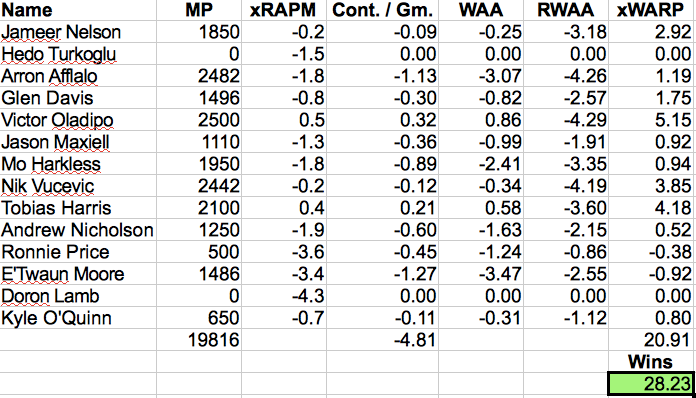
The Orlando Magic this year have got promise and one of my favorite young players to enter the league in a while in Victor Oladipo. They also have a long way to go to be any sort of winning basketball club. Young players and thus young teams tend to struggle on the defensive end, and teams without an established star player to act as the center of the team’s solar system, allowing the lesser lights to settle into planetary rotation, tend to fall into offensive blackholes. The Magic tick both those boxes, and as a result, they probably won’t win very many games this year.

Relative to their likely low winning percentage, they should still be a fun watch, as Oladipo is the rare perimeter rookie who has the tools, determination, and awareness to make a positive impact on that end, and he has some playmaking ability on the other end. In addition, the continued development of Tobias Harris and Nikola Vucevic piling up double doubles is enough to make things interesting. So what do the numbers from Nathan Walker and my guesses on minutes suggest is a likely win total for this team?

After adjusting the projection for wider league context, the Magic look like a 25 win club. Not great, Bob! But this isn’t a team that’s interested in winning this year. Orlando is, as literally everyone you will read about this team will no doubt inform you, playing the long game. They’re adopting the rebuilding model of the former Sonics, now Thunder, along with fellow expected cellar-dweller, Philadelphia. No shame in that, really. They don’t have the means to go out and get much in the way of established veteran talent and the aforementioned trio of Oladipo, Harris, and Vucevic need developmental minutes. If Oladipo is as good as I think he will be and if the Magic are able to hit on their expected high draft pick in next year’s loaded draft, the future looks much brighter for Orlando than their record this year might otherwise indicate. This is a team that could be a sneaky fun League Pass team, if you’re into watching young players develop and get better, and just want to see Nik Vucevic grab ALL OF THE REBOUNDS.

Projecting the NBA using xWARP: Los Angeles Lakers

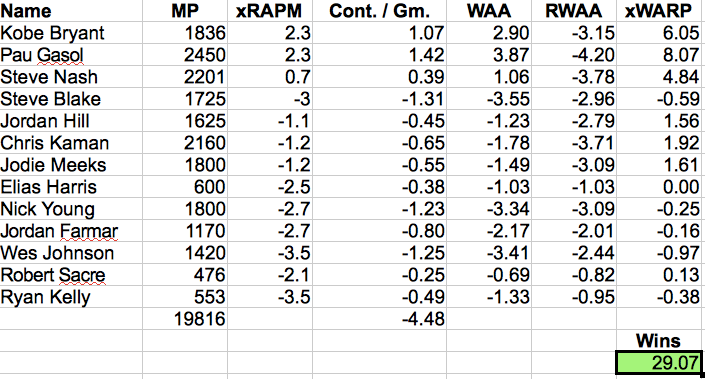
I’m not going to tip-toe around this: the Lakers are going to be awful this season. Kobe will not be ready to start the season and may not be the same great player he has been. Even if he is, the rest of the roster the Lakers have assembled following the departure of Dwight Howard is so, so poor. Steve Nash is a husk of the player he was when he won the MVP trophy twice. Pau Gasol is still pretty great, but when you’ve got such luminaries as Wes Johnson, Nick Young, and Chris Kaman expected to play a major part in your team’s hoped for success, well you just shouldn’t expect very much success, even with a fully healthy Kobe Bryant- which the Lakers just are not even likely to have, at least not until at least sometime in December.

The Lakers struggled badly to eke into the playoffs last year with one of the two best centers in the league on their roster. Yes, Dwight Howard was still that impactful, even with the injuries and the frustration and the disjointedness he seemed to suffer from in his lone year in Forum Blue and Gold. The Lakers replaced him with Chris Kaman, who is just not very good. He’s a below average player replacing one of the very best at his position. That’s, obviously, a huge deal. Wesley Johnson and Nick Young are also just not good at NBA level basketball. They have talent, to be sure. Young, in particular, has no problem creating shots for himself, especially off the dribble, which is a useful skill, but he has no interest in playing anything that might vaguely resemble defense and his propensity for difficult, off-the-dribble, contested jump shots- while entertaining- is just not winning basketball. Just how bad can we expect, by the numbers, for the Lakers to be?

After adjusting for the wider league context, the Lakers Net Rating is -5.6, which translates to a roughly 26 win team. That’s pretty awful, but it’s about right for what Lakers fans should expect from this season. If Kobe is able to return early and play more than 2200 minutes this year, they might scrape up to 30–32 wins, but honestly, what would be the point?

The incoming draft class of 2014 is being hailed as the best since the LeBron-lead class of 2003 and if the Lakers aren’t going to make the playoffs- and they aren’t, Laker fans- why should Kobe rush back early or play extended minutes when he does return? Of course, this is Kobe Bean Bryant we’re talking about, so I would not be at all shocked to see him return to the floor and push himself to play 36–38 minutes a night as he tries, in vain, to drag this awful roster in the playoffs. The guy lives for a challenge and will absolutely want to try to prove all the naysayers like yours truly wrong.

It’ll be fascinating and cringe-inducing to watch him try, but I hardly think I’ll be able to look away- and it’s not like I’ll have much choice, as the Lakers are still going to be playing a staggering twenty-nine nationally televised games, despite their frankly pretty awful roster and irrelevance to the NBA’s big picture this season.

Projecting the NBA using xWARP: Utah Jazz

The Utah Jazz won 43 games last year, which — in a stacked Western Conference — got them the privilege of finishing 9th, missing out on the playoffs, and placed them in the no man’s land of the late lottery. This offseason, the Jazz allowed their best player, along with another of their better ones to leave for nothing in return. I’m speaking, of course, about Paul Millsap and Al Jefferson, respectively. Millsap went to Atlanta where he figures to make it back to the playoffs. Jefferson, bizarrely, was able to grab more years and money per year than Millsap, despite Millsap’s overall superiority. Jefferson, though, will have to accept not making the playoffs this year, and the strong possibility that he won’t see the postseason at all in the 3 years he’s now signed to play for Charlotte. The Jazz weren’t interested in committing the sums of money needed to retain either player, especially when the ceiling of that team was the Western Conference playoff bubble.

Utah also, understandably, wanted to use this year as an opportunity to find out exactly what they have in their young big men Derrick Favors and Enes Kanter, whose minutes were limited playing behind Millsap and Jefferson. The Jazz also declined to use their cap space to sign any free agents, instead opting to acquire assets to rent their cap space to the Golden State Warriors. The result is that the Jazz should be a fair bit worse on the court this year but have a clear plan for escaping their current state of non-contention. The plan is clearly to develop their young talent and acquire assets and then use that talent and those assets to form a group worth betting on. In the meantime, though, just how bad should we expect the Jazz to be- by the numbers?

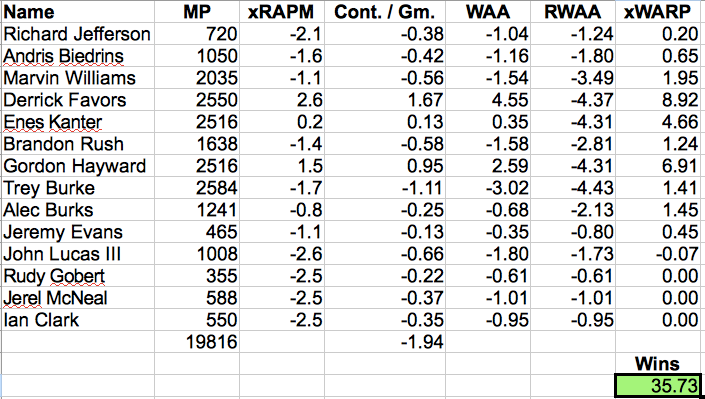
After adjusting for next year’s projected league context, the Jazz’s projected Net Rating is -3.05. Such a projected Net Rating would make them, roughly, a 33 win team. It should come as no surprise, but Derrick Favors, Enes Kanter, and, rising star on the wing Gordon Hayward figure to do most of the heavy lifting for next year’s Jazz. Alec Burks figures to be a slightly below average, but well above replacement option at guard, but it remains to be seen whether Tyrone Corbin plays him the minutes he deserves. I’ve projected Burks to get less minutes than his relative talent on the team would suggest is optimal, but Coach Corbin has generally not played him as much as he deserves, surely much to the consternation of Utah faithful.

I’ve also projected rookie point guard Trey Burke to play quite a few minutes, as I suspect that the use of a lottery pick to draft him and the Jazz’s complete organizational lack of incentive or desire to win games this season make betting on Burke to play a lot of minutes a good idea. Burke figures to be solid for a rookie, with a projected -1.7 xRAPM, he should be solidly above replacement level. As a starting point guard, this year’s iteration of Burke will likely leave something to be desired, but this is a year for learning on the job and I expect Trey will eventually be a pretty good player.

The Jazz will be bad this year, but they should be a fun watch, especially for hoop heads who enjoy watching guys as they progress from prospect to their fully-formed, best selves. The Jazz feature players in various states of development, but most of them are closer to the prospect end of that particular spectrum. That reality will lead to some inevitably ugly basketball, but the talent level that Favors, Kanter, Hayward, Burke, and Burks possess should lead to some genuinely fun basketball at times. For now, those fun moments and the knowledge of the plan in place will have to be enough for Jazz fans.

Projecting the NBA using xWARP: Philadelphia 76ers

Projecting the 2013–14 Sixers is a nightmare. The Philadelphia squad looks, quite clearly, to be tanking the season. Nearly all of the players on their roster are being thrown into roles for which they are terribly ill-suited. Thaddeus Young: Best player on an NBA team? James Anderson: anything more than on an off-the-bench guard? Michael Carter-Williams: starting point-guard in the NBA? These are not questions that any of these players should be asked to answer, but the Sixers aren’t trying to win and here we are.

The trouble is, when projecting future performance in xRAPM, most players tend to occupy similar roles from year to year and thus it’s much more likely that their rating by xRAPM- or any flavor of adjusted-plus minus, for that matter- will look pretty close to the prior year, but when you ask players to do radically more than they have traditionally been asked to do, then their overall impact is very likely to suffer. As a result of this, I would take the win projection that Nathan Walker’s numbers with my minutes estimates produce (shown below) with a giant helping- like a dried up ocean’s worth- of salt. Additionally, the Sixers weird roster construction inevitably throws off what would be more accurate wins projections for the rest of the league. As a result, at the end of all my projections, I will probably write a post with my own subjective- but informed by the stats — guesses as to where teams will come out in terms of records next year. In any event, what do the (probably very wrong) numbers look like?

After adjusting for the wider league context, the Sixers’ projected Net Rating is -3.22, rather than the -2.11 shown above. A -3.22 Net Rating results in a projected 32 win team. Frankly, I would be shocked if the Sixers were able to win even half that many games. It seems that Vegas agrees with my subjective assessment, as the Over/Under for this year’s Philly squad is set at 16.5 wins.

The reason the Sixers rate out so well in this analysis is that they have a team full of guys that in their prior, less demanding roles were fully capable of being replacement level or above. These Sixers have very few players who would have projected as sub-replacement level, had they stayed in their prior roles, and their rookies, Michael Carter-Williams and Nerlens Noel- both of whom will likely be expected to play heavy minutes — actually project to be near average level players. Oh, and Thad Young, as it turns out, is pretty darn good, though certainly not someone you’d want as your best player. It’s worth watching whether xRAPM’s relative love for this Sixers team is as off as Vegas, the rest of the basketball-watching world, and I, subjectively, think it is. I’ll also be watching to see if the Sixers trade Thaddeus Young, in order to go with the full-on, totally unabashed tank.