Up at BlogaBull: The Bulls Strange Inability to Defensive Rebound

Through 4 games, Tom Thibodeau’s defense is outside of the league’s top 10 in points allowed per 100 possessions and that is, obviously, very surprising. Granted, Chicago is 11th in defensive efficiency, so they are barely outside of the top 10, but given that under Thibodeau the Bulls have finished 1st, 1st, 5th, and 2nd in overall defense in the last 4 seasons, it is a bit surprising to see them anywhere but the very tip top of the league’s defensive rankings, even at this early juncture.

More at: http://www.blogabull.com/2014/11/6/7162997/the-bulls-strange-inability-to-defensive-rebound

Up at BBALLBREAKDOWN: Pau Gasol Beat Up the Knicks, But Might Be Slowing Down

The subject of this article might not seem the most timely, given that Pau Gasol just beat the stuffing out of the New York Knicks in the Chicago Bulls’s season opener, recording an efficient 21 point, 11 rebound night in just 29 minutes of play. In fact, this might all end up being a bit of nagging worry that doesn’t amount to much of anything at all. But although the Knicks’ interior defense is incredibly bad, there were some not so great signs for Pau’s prognosis in that game, ones that were also evident during the pre-season as well.

More at: http://bballbreakdown.com/2014/10/31/pau-gasol-beat-up-the-knicks-but-might-be-slowing-down/

Never Hate a Player: On Doug McDermott

[Ed. note: This piece originally ran on July 23, 2014 on a site where all traces of my former presence, along with that of all of the other members of the team, has been wiped away. I didn’t want it to disappear from the internet, so I’m reposting it here, where I have control over what happens to it.]

I am dumber than I like to think that I am. From time to time, it’s important to remind myself of this. This article is me doing just that.

It is often easy when writing about sports to fancy yourself just as qualified as anyone else, including say general managers and talent evaluators, to say whether a player might be bad, average, good, or great. This is, for the most part, harmless, and in some cases, it is possible to outperform the average or bad general manager, if you’re pretty good at scouting talent (like all of the armchair GMs among us would like to believe we are). But this attitude can morph into the worst kind of narcissistic hubris, and well, make you (and when I say “you,” understand that I mean “me”) come off as a bit of an ass. Now, front office types do not have a corner on the market for knowledge about the game, and this should not read like an argument or claim that they do. What I’m wrestling with is that none of us has a perfect understanding of the game, and we’re all learning new things every day we’re lucky enough to watch the world’s other beautiful game. It’s easy to be blind to that. It’s so easy, especially in the super overreactionizer that is Twitter, to have a strong reaction to something and spew it out without really stepping back to question your own assumptions.

It’s quite hard to challenge those assumptions regularly; it’s so much easier to allow them to calcify and constrict my thinking. It requires no effort at all to fall back on my default setting: I know this and that and this too about basketball. But, then, every once in a while, I get to take a moment and breathe and really think, and what I always come back to is this quote from Socrates:

I know one thing: that I know nothing.

It is probably the most important sentence I’ve ever heard about the nature of knowledge. I should always be striving to learn and understand better. Whenever I decide I know something, I’m lost, because I’ve stopped learning.

This is all a bit abstract, so let me be more concrete. When the Chicago Bulls, my favorite basketball team, traded a bunch of assets to acquire Creighton star Doug McDermott, I basically had a Twitter meltdown. McDermott is probably one of the best shooters in the world on a team that was terrible at scoring last year, but all of my favorite statistic-based models cast lots of doubts about whether Doug could play at the NBA level. He didn’t pass very much, he basically never got blocks or steals, and his rebounding was merely decent. McDermott’s low block and steal rates and just okay rebounding made me worry about his athleticism, as those three stats have traditionally been pretty reliable at predicting which players will have the athleticism to hang in the league and those who won’t. The concerns about McDermott’s athleticism matched my own eye test concerns about him. So I decided I knew who Doug McDermott was as an NBA player before ever seeing him play in the NBA. I ignored people, like my friend Ricky O’Donnell of BlogaBull, who pointed out Creighton’s ultra-conservative defensive scheme as a reason for his low defensive counting stats. I scoffed off people who told me he was a good body position defender. I disregarded the common-sense idea that when you’re scoring as much as McDermott did and moving all over the court non-stop with literally five defensive players all aimed at stopping you, maybe defense takes a bit of a backseat. I stopped thinking and started ranting. I was lost.

The statistical models I love have had a pretty good success rate, especially when compared with the average general manager in the NBA, but they’re not infallible. There are plenty of misses, just as there are with any attempt to predict the future of very young men making the transition to a totally new atmosphere and level of competition. There are simply too many things we can’t know at the time of the draft which effect how well a player will do at the next level. How they played in college or internationally and their resulting counting stats is a big piece of that puzzle, but it is only part of it. I ignored that, too.

I watched Doug McDermott in summer league, and many of my concerns still linger. He probably won’t score as prolifically as he did in college and his lateral quickness is not great. But McDermott is so, so smart. He makes extremely quick decisions with the ball, which is a still undervalued skill and its value is multiplied exponentially by the threat he represents as a shooter and floor spacer, especially given his lightning quick shooting release. He’s going to bend defenses, just by virtue of these two skills. He’s also a much better passer and decision-maker than his low college assist totals would suggest. Additionally, McDermott is, as I was told, a solid body position defender, who will mostly funnel players towards his help defense- perhaps not coincidentally, the Bulls have two of the league’s very best help big men in Joakim Noah and Taj Gibson. Yes, McDermott will give up blow-bys to more athletic players and yes, that will be frustrating when it happens, but it won’t hurt as much as it might on another team because of those two big mobile guys behind him. Context matters very much in basketball, and well, maybe on draft night and after I didn’t think enough about the context in which McDermott will be operating. The defensive warts can be more easily hidden in Chicago than nearly anywhere else and his skill-set is a much needed one on any team, but especially for these Bulls.

Film Crit Hulk is one of my absolute favorite writers, and he has a tremendous piece which centers around a bit of advice given to him by the famed director, Quentin Tarantino. During a conversation in which a younger, perhaps less thoughtful Hulk ranted against a movie he “hated,” Tarantino told him, “Never, under any circumstances, hate a movie. It won’t help you and it’s a waste of time.” Tarantino went on to more fully explain that there is value and things to learn and enjoyment to be found even in the bombs or, for our basketball-watching purposes, busts. Tarantino finished his advice by saying of movies, “They’re gifts. Every f*cking one of ‘em.”

I am much less sure than I was about what sort of player Doug McDermott might be than I was on draft night. Part of that is a function of his summer league play, but a bigger part of it is me allowing myself to embrace that I don’t know nearly as much as I sometimes think and act like I do. What I do know is that regardless of whether he turns out to be a “bomb” or another “hit” for the Bulls front office, I’ll learn from watching him play. I’ll learn from seeing his struggles or successes and the how and why behind them. I’ll be entertained, as I always am, by the process. Doug McDermott is a gift, just like every player which I have the privilege to watch and root on.

Re-doing work already done, with better results

I mentioned in my last post that I would be re-doing my projections for the 8 teams that I had already done with new, better numbers courtesy of Nathan Walker. The other day, Nathan posted his projected xRAPM numbers for just about every player in the league (save for the incoming rookies, for whom I will still be using the Hickory-High projected numbers). Now that I have the numbers from Nathan, I have gone ahead and re-done the projections on the previous 8 teams I had finished working on and posted about. The numbers don’t change too much, although, it’s notable that Miami is now tops in the East, with the Thunder and Rockets duking it out atop the West. Here are the projected wins totals for the 4 teams I had done out East:

Heat: 59 wins

Nets: 57 wins

Bulls:* 56 wins

Pacers: 52 wins

And for the 4 teams I had completed in the West:

Thunder: 59 wins

Rockets: 59 wins

Clippers: 56 wins

Spurs: 53 wins

Each team’s name contains a link where you can see the projected xRAPM and minutes for each player, so you can make whatever quibbles you might have with those. I feel these win totals seem like better bets as far as getting things right from a big picture perspective, because they don’t have the wildly optimistic 60+ win projections for anyone. Now that I have all the numbers I need, I will be continuing the projections. Tomorrow: the New York Knicks.

* For the Bulls, Derrick Rose did not have a projected xRAPM from Nathan, owing to his absence for the entire season last year, so I just used his xRAPM from his last season played (11–12) of +4.3. That may prove too optimistic and if that’s the case, you can discount the Bulls accordingly.

Image from koalazymonkey via Flickr.

Projecting the NBA using xWARP: Brooklyn Nets

Last time out, I explained the method I would be using to project the records for the 2013–14 season. There was a lot of dense explanation that I won’t cover again in this post. You can re-read it here. This post will be about updating the method to take into account new research from Jeremias Englemann on aging and RAPM and also to try to project the new rookies entering the league based on projections done over at Hickory High by Cole Patty, Jacob Frankel, and Jam Draper. Finally, I’ll show the updated results for the Bulls and also discuss what this off-season’s biggest splash-makers, the Brooklyn Nets, should look like provided their health holds up.

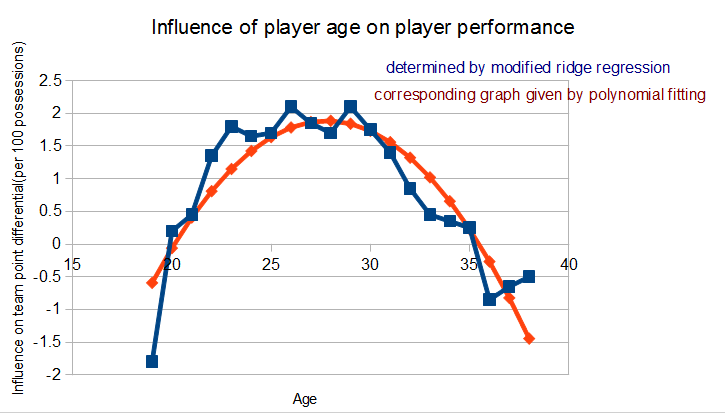
First up, aging. Aging affects performance, obviously. It cuts both ways. As players get stronger and smarter when they are younger, they tend to perform better year over year. Eventually, usually at around age 30 or so, they start to decline, due to the negative affects of aging and a lifetime of basketball played. Jeremias Engelmann wanted to know the effects of aging on average performance under RAPM. So he did some research and came up with the following graph:

image

As a result of that graph, I decided to add adjustments to the xRAPM of each member of every team based on the expected change in their performance based on the change in their age. Here are the numbers that I used, based on an eyeballing of the graph provided by Jeremias:

Age 19 to 20 = +.6

20 to 21 = +.4

21 to 22 = +.4

22 to 23 = +.35

23 to 24 = +.3

24 to 25 = +.15

25 to 26 = +.1

26 to 27 through 28 to 29 = 0

29 to 30 = -.1

30 to 31 = -.2

31 to 32 = -.2

32 to 33 = -.3

33 to 34 = -.4

34 to 35 = -.4

35 to 36 = -.6

36 to 37 = -.6

37 to 38 = -.75

Second, I wanted to try to get a projection of what rookie performance for this year might look like. I looked around for projections in RAPM of the incoming rookie class and the closest thing I found was 4 years in the league RAPM projections done by the guys at Hickory High mentioned earlier. Unfortunately, 4 year in projections don’t help me for projecting the league for this year. So I subtracted out the RAPM performance bumps those players would have expected to receive via the aging curve over the 3 seasons following their rookie year from their 4th-year RAPM projections to try to approximate a guess as to what their production might look like for this year. It is, admittedly, a janky solution. But it’s the best I could figure for the time being. If I find a better solution, I will change things and post updated results.

Okay, now on to the more fun stuff: projecting the Bulls and the Nets with the updated method.

image

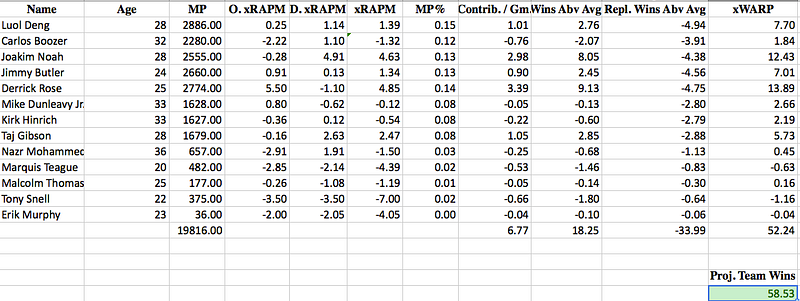
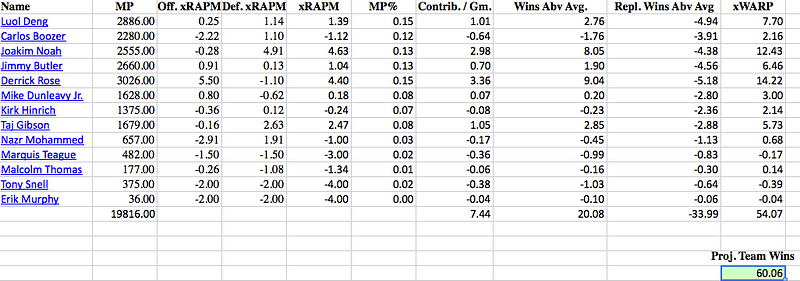
The Bulls look more or less the same as I had previously suggested. Tony Snell’s projection is much worse as the 4-year RAPM projection had him as one of the worst projected players drafted. Erik Murphy looks about the same as I had projected him last time. I don’t expect either of them to play significant minutes so this change had little effect on the Bulls estimated win total. I believe Derrick Rose will play his normal level of minutes as he has had plenty of rest and should be back, better than ever. Rose, Jimmy Butler, and Marquis Teague project to have improvements based on their ages which helps the Bulls, while Carlos Boozer, Mike Dunleavy, and Kirk Hinrich all project to decline slightly. The rest of the major minutes contributors should be more or less the same. As a result, I have the Bulls pegged at about 58 to 59 wins, which is right in between where my two earlier projections of 57 and 60 wins would suggest. So the age adjustment did not make a huge difference for the Bulls.

One team for whom the aging adjustment did matter was the Brooklyn Nets. Prior to age adjusting their roster, the Nets looked like a 63 win team. This is how their projection shook out:

image

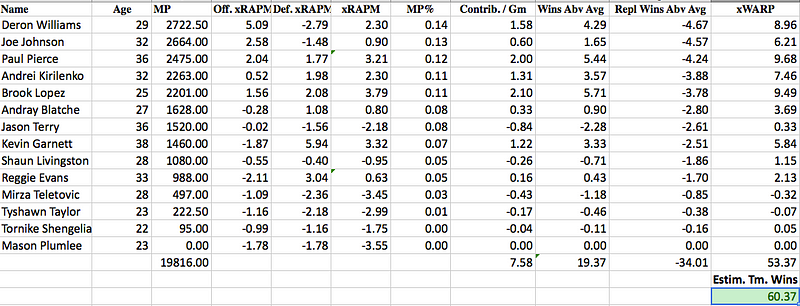
After adjusting for age, however, the Nets still look great. They project as a 60 win team, provided they stay reasonably healthy. I made a point of keeping Kevin Garnett’s minutes low relative to his career average, as he has stated in interviews that he can no longer handle the heavy minutes loads that he has been tasked with his whole career. The good news, for Garnett and Nets fans, is that it looks like he will not need to be asked to handle such heavy minutes. The Nets appear to be a juggernaut in waiting. Here are the results with the age adjustment:

image

I have seen the Nets compared to this year’s Lakers as a top-heavy team full of oldsters assembled together to take a shot at a title, with the implication being that the Nets will fall apart just as spectacularly as those Lakers did. I think this is wrong because these two teams could not be more different in terms of roster construction. This Nets team is DEEP. Eight of their top 10 players in projected minutes played are positive xRAPM contributors and ALL of the top 10 in projected minutes played are above the replacement level of -2.5 in xRAPM.

By way of contrast, the 2012–13 Lakers gave over 1300 minutes to Earl Clark (-4.14 xRAPM), 1175 minutes to Steve Blake (-3), plus over 1500 minutes combined to Chris Duhon and Darius Morris (-3.95 and -4.93, respectively). Steve Nash was merely above average (+.7) when he played and on top of that, he was hurt often (hence all the minutes for Duhon, Morris, and Blake). This year’s Lakers squad had little depth and suffered significant injuries to key contributors (Pau Gasol, Steve Nash, and Kobe Bryant) and saw Dwight Howard play when he likely should have been recovering from back surgery. Dwight was awesome (+5.54), but he wasn’t as great as he can be (+8.8 in 2011–12, +9.7 in 2010–11). This is not to say that the Nets will necessarily be much healthier at the top than the Lakers were, but it is to say that they are better prepared to handle injuries thanks to their far superior depth.

If these Nets stay reasonably healthy and Jason Kidd is worth a lick as a coach, they represent a significant threat to the Heat, Bulls, and Pacers at the top of the Eastern Conference. They may even be the favorites to win the regular season Eastern Conference crown, under this analysis, if not in Vegas. Speaking of Vegas favorites, the Miami Heat will be next up in this series of posts.

Image from Keith Allison via Flickr

Projecting the NBA using xWARP: Chicago Bulls

I really like advanced basketball stats and trying to learn as much as I can about them. As a result, I spend an inordinate amount of time perusing the threads over on the Association for Professional Basketball Research (APBR) message board. Through my reading there and elsewhere (usually following links I found there), I have come into contact with a statistic called regularized adjusted plus-minus or RAPM for short.

Adjusted plus-minus is essentially an approach that attempts to use on / off data to determine how much a given player contributes to the margin of victory (or loss as the case may be). It does this through regressions on lineup data found in play-by-plays to determine the +/- of a given lineup over a given shift that they were out there. The regressions then spit out numbers which show how much a player is likely worth + or — per 100 possessions. The problem with adjusted plus-minus in its regular form is that is quite noisy and that there are collinearity issues. Collinearity, in this context, just means that there are often players who play together a lot and thus it is hard to disentangle their value in +/- from one another. Additionally, the sample sizes of minutes played by each lineup are small, which leads to the aforementioned noisiness in the data.

RAPM improves upon the regression-based approach of standard adjusted plus-minus by using a technique called regularization or ridge regression. It’s basically a high level math technique that statisticians use to deal with the problems presented by the normal adjusted plus-minus type of regressions. It leads to much less noisy, more accurate results.

Finally, xRAPM, the subject of this post, includes a box-score based statistical prior to further inform the player ratings and thus improve the predictive effectiveness of the metric. All of this is a long-winded way of saying that xRAPM is the most accurate +/- metric that exists for predicting future results of which I’m currently aware. As a result, it’s the method that I will use to project each of the 30 teams’ records in the NBA next year, based on estimated minutes, and impact of the players on each team. The numbers for xRAPM are available here. (Thanks to Jeremias Engelmann for publicly providing the data).

xRAPM is a great tool for projecting, but I wanted to translate it to something more tangible to the common fan. Wins. After talking to Nathan Walker of the Basketball Distribution on Twitter, I learned a way to convert xRAPM into WARP (wins above replacement player). In short, xWARP (for short) examines the number of wins a player contributed over what an available replacement would provide in the same number of minutes. I set replacement level at a xRAPM of -2.5 points per 100 possessions in xRAPM. Nathan uses -3.5, according to our Twitter conversation, but the end result of projecting is the same.

Now, for the true purpose of this post. I will be examining every team in the league by looking at their xWARP for this past season and trying to project their xWARP following their offseason moves. I’m starting with the Central Division and the Chicago Bulls, because they’re my favorite team, I know them best (and can best guess minutes distributions), and because their offseason is more or less done (save a cheap big man or guard signing, which are likely to be replacement level players themselves, so have basically no impact on this math).

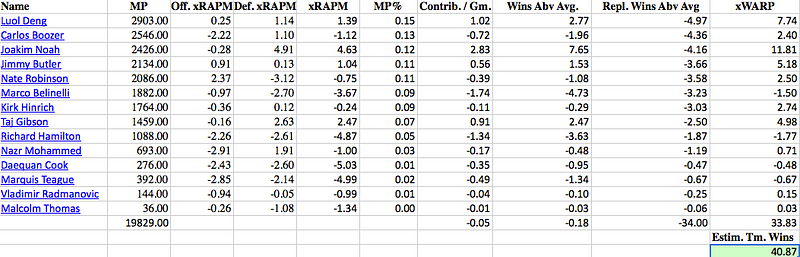
The Bulls this year were a team that outperformed their point margin by about 3 wins. Their MOV was a relatively small +.32. Subbing that into the standard MOV to wins converter equation from The City’s Advanced Stats Primer ( 2.54*MOV+41 = wins), the Bulls should have won about 41.8 games, so basically 42 wins. Instead, the Bulls were statistically lucky. They won 3 more games above their expected win total. A lot of that probably had to do with Marco Belinelli’s 3 ridiculous game winners. But basically, the Bulls were better than expected based on how close they played their opponents. This was not a 45 win team, it was more like a 42 win team. Here are the numbers:

image

By xWARP the Bulls look more like a 41 win team but the point is roughly the same. They overperformed their expected win performance level based on what amounts statistically to luck.

So the Bulls just signed Mike Dunleavy Jr this year, a good player, and they get their MVP, Derrick Rose back, so surely they will win many more games this year, right? Short answer: yes. But let’s look at the numbers.

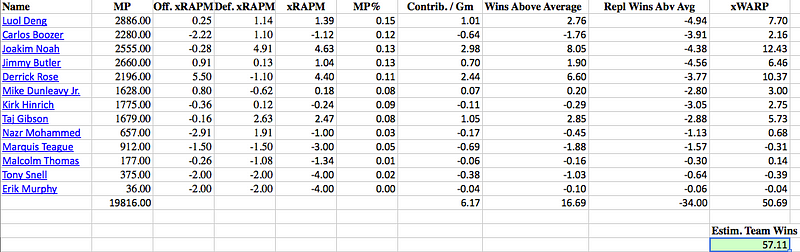
I projected the Bulls’ minutes distribution for next year using a combination of a method described here by Kevin Pelton formerly of Basketball Prospectus and currently of ESPN.com Insider, based on a study by basketball statistician Ed Kupfer and my own intuition about how many minutes a player would play per game played based on rotations. Pelton describes the method as setting the expectation for a player starting at 76 games and going down about one game for each six missed the previous season and one for each 20 missed two years ago. Two years ago was a 66 game season, so I used 16 games instead of 20 games when calculating that number of games in the projection. I did two projections. I projected what the Bulls would look like with Derrick Rose playing just 61 out of 82 games (the number according to the Pelton-Kupfer projections) at his usual 36 minutes a game. Then I looked at what they would look like if Rose matched his career high in minutes played of 3026 minutes (a/k/a the scenario where he’s truly 110% in Rose-speak). In the latter scenario, I subtracted Rose’s additional minutes from Kirk Hinrich and Marquis Teague, the back-up point-guards. Here are the results for the less optimistic, (probably) more realistic numbers for Rose playing about 2200 minutes over the season:

image

The Bulls here project as … a 57 win team. After not having their MVP for an entire year and winning 45 games (and really being more like a 41–42 win team) a 57 win season with him playing nearly 2200 minutes would be great for Bulls fans and should signal return to the East’s top tier. What about if the Bulls get 110% super-healthy Derrick Rose and he plays 3026 minutes?

image

Congratulations Bulls fans! With a very healthy Rose, you’re looking at … a 60 win team! Adding about 800 minutes to Rose’s minutes projection yields an additional 3 wins in xRAPM. Basically, if DRose is back to the level that his old self and able to play 2010–11 level minutes, then the Bulls will look very much like the team that won 62 games that year and 50 out of 66 the following year. Even if Rose is only able to go 61 out of 82 games, the Bulls still look to be a high 50 win team. Of course, there are caveats, in all of this. Luol Deng and Carlos Boozer have both been declining by xRAPM for 3 years in a row. They may further decline. Rose may not be at the level that he was before his injury right away. There could be another major injury to a significant piece of the core group (*fingers crossed, knocking on wood that this doesn’t happen*).

But there are potentialities that would allow the Bulls to look even better. Jimmy Butler improved quite a bit over his rookie xRAPM of -.7 to a solid 1.04 this past year and he’s young enough he should continue to improve. Joakim Noah is still just 28 years old and is in his peak years, so he will likely remain the same or slightly better. Marquis Teague may improve more than I have estimated (I assumed he would be at least a -3 in xRAPM this year, slightly below replacement level still but not as bad as his terribad previous season xRAPM of nearly -5). The new rookies may be better than the -4 xRAPM level that I have pegged them at, just to be safe, and may get more minutes if they outplay the older players, though with Thibs at the helm, I highly doubt the rookies get many minutes, as is clear from my minutes projections. Finally, Derrick Rose may be better than ever. He was on a solid upward trajectory prior to his injury and he’s had a long, long time to improve on his jump shot and other skills. He’s been able to observe and watch for defensive tendencies. Now he’s coming back after taking his time with his recovery and feels 100% right. I’m certainly not going to rule out him possibly ratcheting up another level. I’ve learned not to doubt the man.

After all that dense reading, I leave you with a whole bunch of awesome DRose highlights:

Image from Keith Allison via Flickr

The Chicago Bulls have, wisely, agreed to sign Mike Dunleavy Jr.

Boozer and Lil Dun’ reunited!

I like the Chicago Bulls. Okay, that’s a lie. I love the Chicago Bulls and I have for basically my whole life. In the past, the team’s ownership and front office have done a lot of things to make me question my loyalty to the red and black. They signed Ben Wallace to a massive free agent deal, as his athleticism was waning, and then compounded the mistake by trading away the young, promising Tyson Chandler for basically nothing besides an expiring contract, which they then failed to use in a trade to make the team better. They refused to re-sign Ben Gordon because of money (which it turned out was the right move). They signed Kirk Hinrich last off season for 2 years, $8 million, when there were younger, healthier, better options. They dismantled the Bench Mob that was so great in 2011 and got nothing in return for it. They didn’t match Omer Asik’s restricted free agent offer sheet from Houston. They avoided paying the luxury tax every year in its existence, until last year, where they only ended up paying it because they couldn’t find any team with cap space interested in absorbing the (dumb) contract to which they signed Rip Hamilton. Their GM just recently fired their amazing head coach’s lead assistant, Ron Adams, over some petty in-fighting, power playing nonsense. So, yeah, I have had a lot of complaints, over the years, about the people running things for my favorite basketball club. But not today; because today, why today they have done something pretty great. Today, the Bulls agreed verbally to sign Mike Dunleavy Jr. for 2 years, $6 million, according to ESPN’s Marc Stein.

This sort of reaction to a guy signing for the mini-midlevel exception might seem surprising. Well, it’s no overreaction, and here’s why: the Bulls have one glaring weakness on offense and it’s that they can’t shoot straight from three and Mike Dunleavy is a dead-eye three point shooter. Dunleavy shot a blistering 43% from three last year for the Milwaukee Bucks on 5.5 threes attempted per 36 minutes. Dunleavy also fits the Bulls offense to a T. He is excellent at moving off the ball, in the sort of pin-down actions that the Bulls have been quite fond of running with Kyle Korver, then Rip Hamilton. With Derrick Rose back, Dunleavy should see even better looks than the ones he got for a pretty mediocre Bucks team last year, playing alongside chucking guards, Brandon Jennings and Monta Ellis. Dunleavy also rebounds the ball well for a wing player, passes the ball deftly, and is a solid, if unspectacular defensive player. Dunleavy is basically a perfect fit for what the Bulls need in a backup wing player and should have coach Tom Thibodeau’s trust right away. The commitment to use the MMLE also seemingly indicates a change in the team’s stance on spending. After committing to Dunleavy’s $3 million dollar salary this year, the Bulls will be deep into the luxury tax, with the new CBA’s harsher luxury tax penalties kicking in this year, it’s very nice to see ownership not shying away from paying out some of their league leading profits to pay for a winner. Maybe Derrick Rose’s brother Reggie’s comments about the need to improve the roster had their intended effect. Finally, the Bulls have clearly made an offseason priority of shooting. Coach Tom Thibodeau mentioned the need for better shooting several times in interviews following the season’s end. Then, the Bulls drafted Tony Snell (a wing who shot 39% from distance in college), Erik Murphy (a floor stretching big man who shot 45% from 3 in the SEC), and now the signing of an elite shooting wing in Dunleavy. The Bulls probably need one more big man, in addition to Nazr Muhammed, who they are likely to re-sign for the veteran’s minimum, again, but this off-season is shaping up quite nicely for the team from Chicago – aside from that bit of nastiness between the front office and the coaching staff linked above, which is admittedly very troubling.

And now just for fun, here’s highlights from Dunleavy Jr. dropping 29 points on the Cavs early this past season. Good times!