Projecting the NBA using xWARP: New Orleans Pelicans

The New Orleans Pelicans were a nice little team this past year- complete with promise, some solid young role players and a neophyte, likely franchise altering big man in the fold. They looked like a team that would add a top 6 selection to pair with their star, Anthony Davis, and later have another likely lottery pick in the much ballyhooed 2014 draft. That would have been one way to go. Many think it was the right way to go. It’s not the way the Pellies (I got you, Zach Lowe!) decided to go, though. Instead, they opted to cash their chips in now and bet on a player in Jrue Holiday who is no doubt talented, but may not be worth the price New Orleans paid to grab him.

The draft rights to Nerlens Noel, whom many observers believed to be the draft’s most talented and promising player, along with their selection in the 2014 draft seems like quite a high price for a very good player who is not in the elite tier of his position. On the other hand, the Pelicans got someone everyone knows is a good player, and there’s some value in that.

In addition, the Pelicans nabbed Tyreke Evans from Sacramento. Evans famously is one of very few players to ever average 20 pts, 5 assists, and 5 rebounds as a rookie. There are all sorts of problems with relying on counting stats per game, but anytime you’ve accomplished something only LeBron James, Michael Jordan, and Oscar Robinson ever did- you’re in good company. The problem for Evans is what came after all that promise in his first season. He was, basically, worse the next two years, before finally reaching roughly the same level of performance as his rookie year, last year. The Pelicans are betting that he’s finally got things figured out and he’s set to take off in new surroundings. If he does, his roughly $11 million annual salary will seem like a bargain on a similar level to that of Celtics point man Rajon Rondo and maybe to a lesser extent, Stephen Curry’s absolute steal of a deal. In order for Evans to reach that point, though, he will have to keep up or surpass his offensive contributions of the past and improve significantly from his, frankly, below-average to bad defense.

There’s hope for these Pellies, though, to play in the playoffs. I have them projected as the ninth best team in the West for next year, but the playoff bubble is also subject to the vagaries of injuries, luck, and teams and / or players surprisingly outperforming their expected level of performance. This is a squad that could easily squeak into next year’s playoffs out West. So how do the projections say they will likely get there?
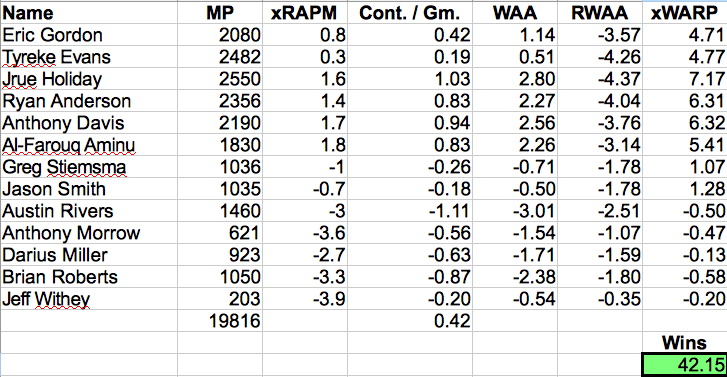
Note: These numbers have to be adjusted for the context of the entire league average, which projected to be roughly +1.11 per team. That’s impossible; average must xRAPM leaguewide must, by definition, sum to 0, so adjusting the Pelicans down to -.69 from their previously unadjusted expected point differential of .42, we get a team expected to win roughly 39 games. That’s about as bubbly as bubbly gets for playoff hopes.

According to Nathan Walker’s numbers Pelicans look to get things done with a team deep with slightly to nicely above average players in the starting lineup, lead by Davis, Ryan Anderson, and Holiday. Tyreke Evans also projects to be above average but not as far above it as you’d like from a guy making the salary he’s slated to make and certainly not as much as those gaudy counting stats from his rookie year would suggest is his potential impact.

The Pelicans also need a relatively healthy year from Eric Gordon, which they project to get here. Gordon’s no world-beater but he’s above average, which is much more than can be said for the sub-replacement contributors behind him in the guard rotation- Austin Rivers and Anthony Morrow. If New Orleans is to really compete for that bottom rung of the playoff ladder, a healthy Gordon is probably a necessity. Here’s hoping he can finally stay on the floor and show more of the talent that made him the centerpiece of the Chris Paul trade for New Orleans.

Image from Keith Allison via Flickr.

Projecting the NBA using xWARP: Minnesota Timberwolves

The Minnesota Timberwolves haven’t made the playoffs in nine seasons. They’ve likely had the talent to make it over the last two years, but bad luck with injuries to their two most important players, Kevin Love and Ricky Rubio, have, unfortunately, blown those hopes to hell. Love and Rubio have combined to play just 171 games of 296 games the two of them, together, could have possibly played over the last two years. Next year, as it always does, provides another opportunity for the ‘Wolves to crack the playoffs for the first time in ten seasons. What do the numbers suggest Minnesota fans can likely expect?

This ‘Wolves squad has 45 win talent, without context. On the other hand, the numbers, as I ran them initially, gave each team, on average, 1.11 points over the required sum of 0 total net points across the league- given that basketball is a zero sum game. Every player making a positive contribution comes, in +/- and thus xRAPM, at the expense of another player or set of players being debited for those positive contributions coming against them. As a result, you can adjust the strength of each team simply by subtracting out those 1.12 points from their total Contribution per Game. When it doing this with the Timberwolves, it makes them a +.31 team. Plugging in to the simple MOV to wins equation (2.7*MOV+41 = Wins), the Timberwolves project as a 42 win team. This jives with their projection in the big schedule spreadsheet, as a 42 win team, when factoring in their strength, the strength of their opponents, and their home court advantage.

Kevin Love

How does Minnesota get there? Kevin Love and Ricky Rubio carry most of the weight, as any even casual Timberwolves observer would expect. Their health is, obviously, of paramount importance for the ‘Wolves to reach their postseason goal. Nikola Pekovic, Kevin Martin, Chase Budinger, Corey Brewer, and Derrick Williams are the lesser lights ranging from slightly above average to slightly below, though, they’re all solidly above replacement and so they should all be helping. Also of note, Shabazz Muhammad projects to be pretty okay as a rookie, by the Hickory High rookie projections, and as a result, he’s an above replacement contributor by these numbers.

For my part, I’ll be rooting for the ‘Wolves. Their fans have dealt with the disappointment of David Kahn’s draft record, the tantalizing frustration of waiting for Ricky Rubio to come over from Spain, and the scuttling of the last two promising seasons due to Love’s recurring injuries and Rubio’s torn ACL. The players, Love especially, must be just as frustrated, if not more so. This is a team that, health permitting, should compete for the right to test themselves against the Thunder or the Rockets or the Clippers in the first round of next seasons’ playoffs. Hopefully the Timberwolves will finally be playing come late April.

Images via wikimedia commons.

Projecting the NBA using xWARP: Dallas Mavericks

The Dallas Mavericks missed the playoffs for the first time in a dozen years last year. Last year’s roster was constructed using something of a holding pattern while the Mavs waited for the big fish in the 2012–13 free agent class, namely Dwight Howard and, to a lesser extent, Chris Paul. Team owner Mark Cuban loaded the roster with 1 year contracts for players with whom the team was more than willing to part, which is just what they did at the start of free agency. Unfortunately for the Mavericks, Chris Paul stayed home in Los Angeles and Dwight Howard took his act, along with his considerable talents, to Houston. At that point, the Mavericks had a choice between another year of 1 year contracts and pursuing a marquee free agent in the 2014 class- the year a certain guy wearing #6 in Miami hits the open market, again- or signing the best players with whom they could fill their roster.

After asking the face of the franchise, Dirk Nowitzki, for his patience for one year, the Mavericks opted not to ask him for further patience as he reaches the twilight of his career. Good for the Mavericks. They’ve built a team that should compete for one of the West’s final two playoff slots and Dirk Nowitzki deserves to be playing meaningful basketball come late April 2014. Plus, Nowitzki is good enough, even at this late stage of his career, that with a little bit of help he’s capable of carrying a team to a playoff series win. Good on Dallas management and owner Mark Cuban for giving him the chance to do just that. So just how much help has Dirk been given and what, exactly, do the numbers say we should roughly expect?

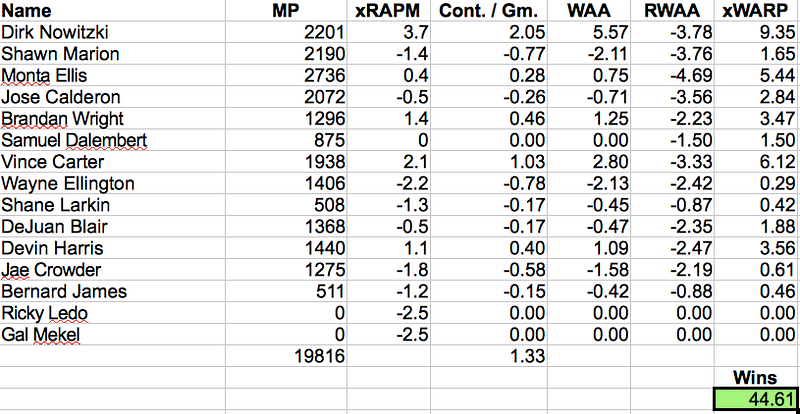
The Mavericks have the talent of a 45 win team, roughly. After plugging their projected relative strength in versus their opponents’ and accounting for home court advantage, my big spreadsheet predicted them to win 42 games, on average. The Western Conference, man. Most of the Mavs’ projected contributions come, unsurprisingly, from Dirk. Mavs management, though, has done an incredible job of getting players who project to be at least at or above replacement level. There are no other stars paired with Dirk, but this is a deep team with two very helpful scoring wings- Vince Carter and the, somewhat unfairly, much maligned Monta Ellis- surrounding the big German. They also added a point guard, in Calderon, who can actually get Dirk the ball in his favorite spots and knock down the open looks Dirk creates, unlike last year’s hot mess at the lead guard spot.

It’s a roster that fits together well; so well, in fact, that given head coach Rick Carlisle’s usual brilliance, this squad could easily out perform that 45 win talent. The Chicago Bulls have made a habit these last few years out of pairing teams that fit well with a brilliant coach to outperform the talent of the squad. I wouldn’t be shocked to see these Mavs run a similar formula, only instead of dominating on defense like the Bulls, this Dallas squad could put together some truly elite offensive stuff, provided Carlisle can rein in Monta Ellis’s worst instincts- a burning desire to shoot off-balance, off-the-dribble 20-footers, mostly.

Image from chrishimself via Flickr.

Addressing a problem with the xWARP projections

In calculating the xWARP projections I’ve been doing, I noticed a worrying problem. The total number of wins projected for each team appeared to be roughly 7% too high. There are only 1230 games, and thus, 1230 wins available for the 30 teams in the NBA to win. In doing my xWARP projections, I had just been posting the win totals as I did each team.

Last night, I finally got around to running the numbers on all of the remaining teams I’d yet to post and summed up team wins for the whole league. Unfortunately, total team wins summed to roughly 1318 wins, which is obviously way too many. There are a number of ways to deal with this problem. The lazy, easy way would be to simply multiply the win totals of each team by 1230/1318 or roughly .933. The top teams then have 55 projected wins and the bottom dwellers would be in the mid to high 20s in wins. This solves the problem, but it doesn’t seem that consistent with reality, so I’ve decided to go another way.

I’ve hinted at wanting to do this before, but my current plan is to go through each and every game on the schedule and utilizing the projected MOV for each team (in the spreadsheets it’s the total Contribution / Game) plus Evan Zamir’s ridge regression work on homecourt advantage, I plan to figure out the win probabilities of each of the 1230 regular season games and then use those probabilities to determine total team win totals. I will then post the updated results. I will be updating the posts that already exist to reflect changes in team win totals after this is all done, and I will also do a master post with the full league projections.

I’m bummed out that the math didn’t work out as well as I’d hoped, but I’m excited to go through the schedule in such detail. The other good thing is that doing things this way acts as a built in strength of schedule adjustment for teams with more or less difficult schedules. Thanks for reading and for your patience while I work out the kinks of all this.

Image from gammaman via Flickr.

Projecting the NBA using xWARP: Cleveland Cavaliers

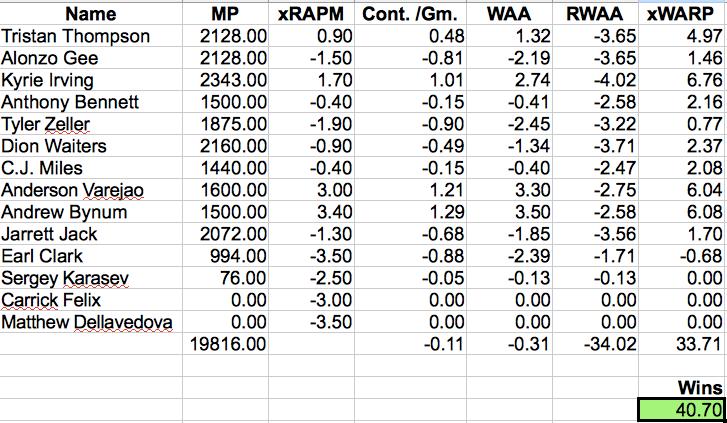
The Cavs had a very interesting offseason. They surprised many when they used their first overall pick on Canadian forward Anthony Bennett. After that, they made a couple of interesting signings. First, they made a priority of snagging veteran combo guard, and sixth man of the year candidate last year, Jarrett Jack. Later, they grabbed swingman Earl Clark from the Lakers, for reasons that remain unclear, save for the possibility that Mike Brown just liked Earl Clark a whole lot in the five games he got to coach him in Los Angeles, though you certainly wouldn’t guess that judging by the number of minutes Brown played Clark. Whatever the reason for the deal, Earl Clark is just not very good at NBA level basketball, so the Cavs signing him for 2 years, $9 million doesn’t make much sense. It’s not a killer deal, in that it has very little effect on the Cavs cap sheet going forward, but there had to be better options to give $4.5 million per annum than Earl Clark. After that strange signing, Cleveland made a very calculated bet on Andrew Bynum’s balky knees, due to his game-tilting impact when he’s able to remain on the floor. I’ve argued before that it was a smart bet. Let’s see how the Cavs project for next year after their offseason moves.

At 41 projected wins, the Cavs look to be firmly within the playoff picture in the Eastern Conference. One thing to consider, though, is that these projections are schedule independent, thus far, and therefore, don’t account for the fact that the Cavs will be playing in the very strong Eastern Conference Central Division. The Central features legitimate contenders in the Pacers and Bulls, along with three other teams, including Cleveland, who should all be in the mix for a spot at the bottom of the Eastern conference playoffs. As a result, things might prove a bit more difficult for Cleveland than, say, the Wizards, who really only have the Heat and Hawks to worry about within their division, with what should be easier games against the lowly Bobcats and the rebuilding Magic. In a tight playoff race, those few easy games could be difference makers.

The Cavs signing of Bynum, based on this projection, looks very solid, as in 1500 minutes, he projects to produce 6.08 wins above replacement by xRAPM (xWARP). Nathan Walker’s projection for Bynum’s xRAPM performance is +3.4, which represents a relatively gentle drop off from his +3.9 in his last season (2011–12). That number may prove too optimistic, but I don’t think it’s totally unrealistic either.

One more thing of note with respect to this Cavs team. Their “best” player by conventional wisdom and the eye test is decidedly not their best player when viewing things through the xRAPM lens. Kyrie Irving is a good player by xRAPM, but he is not the superstar he is labeled by other metrics. This is basically entirely because of his defensive performance, which is, to put it nicely, very poor. Last year, Kyrie was a +2.96 on offense, while giving most of it back by putting up a very bad -2.04 on defense, for an overall xRAPM of +.92. On the bright side, many point guards struggle with defense and then improve as they gain experience and learn their responsibilities. Kyrie projects to improve in overall xRAPM to +1.7 and even that may be underestimating things if Mike Brown can impart all of the defensive expertise inside that head of his.

Dan Gilbert stated at the draft lottery that he wanted to avoid another trip to that most hopeful and depressing night on the NBA calendar, and it appears his front office has done enough to get the job done — provided Andrew Bynum, Andy Varejao, and Kyrie Irving stay reasonably healthy, admittedly a dodgy proposition.

Image from edrost88 via Flickr

Projecting the NBA using xWARP: Golden State Warriors

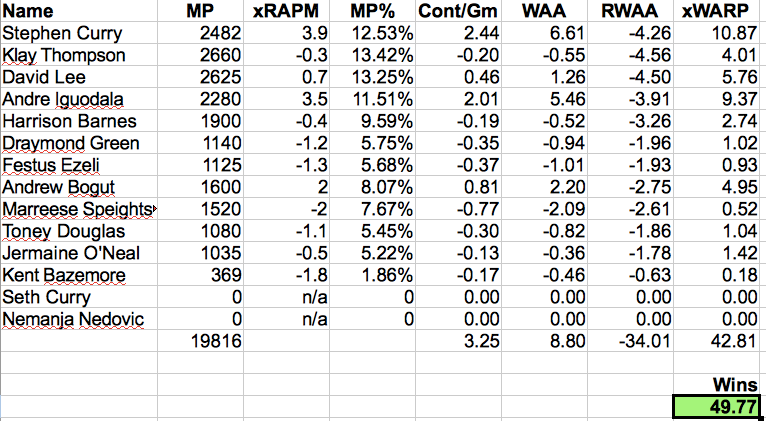
After a great, exciting regular season and post-season run the Golden State Warriors’ front office decided not to rest on its laurels. This offseason, they made a big move to dump bloated contracts plus a couple future first round draft picks to the Jazz in order to free up the cap space necessary to sign versatile swingman Andre Iguodala. Will that move be enough to propel the Warriors towards the top of the Western Conference?

It appears not. The Warriors project to be better than their 47 win record of last year, clocking in at a projected 50 wins here. Three wins of improvement is actually underselling the Warriors projected improvement a bit. Last year, the Warriors had the point differential or margin of victory of a 44 win team. So really a 50 win projection for these Warriors represents a 6 win improvement in quality over the team they were last year. That sounds about right for a team adding a player of Iguodala’s quality, while already being a good team to start.

There are a couple of reasons the Warriors don’t project to shoot up the Western Conference ranks, aside from their overachieving last year relative to their point differential. David Lee and Stephen Curry both project to regress a bit from their numbers last year, according to Nathan Walker’s projected xRAPM numbers. Steph’s projected to clock in at +3.9, compared with a +4.2 last year, whereas Lee is projected to produce just a +.7 compared to his much better +1.4 of last year. This is becoming a bit of a theme for teams that had their best players play very well last year, and it should be. Statistically speaking, it’s more likely than not that a player coming off a career season (or even a very good one relative to their prior performance) will take a small step back towards the mean of their previous career performance than it is that they will produce the same numbers or better.

Additionally, the Warriors lost Jarrett Jack from last year’s squad and have replaced his spot in the rotation with… Toney Douglas? Douglas projects to be an above replacement contributor, to be sure, but he doesn’t project to be as helpful as Jack was. Jack’s xRAPM last year was -.7, whereas Douglas projects to be worse at -1.1. The loss of Jack, expected regression to the mean for the duo of Lee and Curry, added to the fact that this was a club closer to a 44 win team last year than a 47 win team, all conspire to make it seem likely that the Warriors will disappoint the lofty expectations that have arrived with adding Iguodala to a team that already had a nice playoff run last year. On the other hand, 50 wins is certainly nothing to feel shame over and Stephen Curry could always go nova again in the playoffs and lay waste to teams that appear better on paper, so take heart in that Dubs fans.

Image from Keith Allison via Flickr.

Projecting the NBA using xWARP: Atlanta Hawks

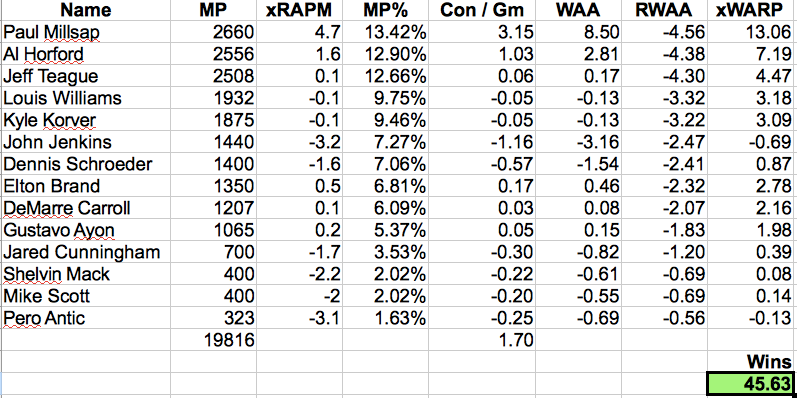
In all of the shuffling around of the offseason, the Hawks quietly made one of the best moves of the entire free agency period. After losing Josh Smith to the Detroit Pistons, the Hawks went out and signed a superior, albeit less dynamic, player for a much shorter, cheaper contract than the one the Pistons gave to the enigmatic Smith. Yes, I’m talking about Paul Millsap and his two year, $19 million deal. Millsap has been an advanced stats wunderkind for years, and last year was no exception. He posted an exceptional +5.4 xRAPM, good for 7th in the entire league and far outstripping Josh Smith’s also very good +3.4 xRAPM. So yeah, the Hawks made out pretty well, if you believe at all in the value of xRAPM.

After the Bucks stupidly overpaid ($5.2 million a year for three years???) for former Hawks big man Zaza Pachulia, who is, in terms of overall impact, a very similar player to Gustavo Ayon, whom the Bucks were forced to waive, the Hawks capitalized on this foolishness and claimed Ayon, a solid rotation big man, off waivers for the relatively piddling salary of $1.5 million a year.

The Hawks then let the market dictate Jeff Teague’s price and matched his restricted free agent offer sheet that he had signed with those same Bucks, rather than bidding against themselves and overpaying the young point guard. Basically, all summer long, the Hawks got value. So after all that how do the Hawks shape up for next year?

The Hawks look like a very solid, mid-level playoff team. 46 wins represents a slight improvement over their 44 win season last year.

A few things to note: Paul Millsap and Al Horford project to regress back towards their previous levels of performance a bit, as is the case with basically all players in the league who had better than their career average xRAPM last year under Nathan Walker’s numbers. Second, I had no way of projecting rookie point guard Dennis Schroeder’s performance for next year, as he was an international player and therefore Hickory-High had no projection for him. I read about him and scouts’ opinions of him and a fair amount of people view him at the outset of his career to be much like Darren Collison. So for the sake of simplicity I projected him to have the same xRAPM as Collison had in his rookie year in 2009–10. As far as minutes go, it’s harder to project minutes for rookies who look to play a fair amount, given that they don’t have previous seasons worth of data to make educated guesses using. What I did for Schroeder, then, was to look at his role, and try to give a reasonable guess for how many minutes he’ll play. For the record, after watching him play in Summer League, I think Schroeder will actually be better than Collison, even as a rookie. I’m not the only one, Schroeder views himself as a player similar to Rajon Rondo, as do others. For these projections, though, I figured I would err on the side of caution and assume that Schroeder won’t be as productive as Rondo. Finally, similar to the problem with Schroeder, I had no way to predict performance from the Hawks newly signed international big man, Pero Antic. So, I went to in-the-game.org, a Euroleague stats site, and looked at Antic’s similarity scores and tried to find any NBA players on the list. The best match for Antic currently in the NBA is the Nets Mirza Teletovic. So, I used Teletovic’s projected xRAPM as a stand in for Antic. Now, given that I had projected Antic to play so few minutes, his performance level is basically irrelevant for looking at the Hawks total wins.

The Hawks under this projection are in the same positional slot as the ESPN Forecast had them, just behind the Knicks, but they project to be a team that wins more games than the merely 40 for which the ESPN voters pegged them. Now, maybe that changes once I have to account for strength of schedule and the fact that overall team wins must sum to 1230. We’ll see, but I would guess the Hawks are at least a .500 team next year.

Image from valdezign via Flickr.

Projecting the NBA using xWARP: Memphis Grizzlies

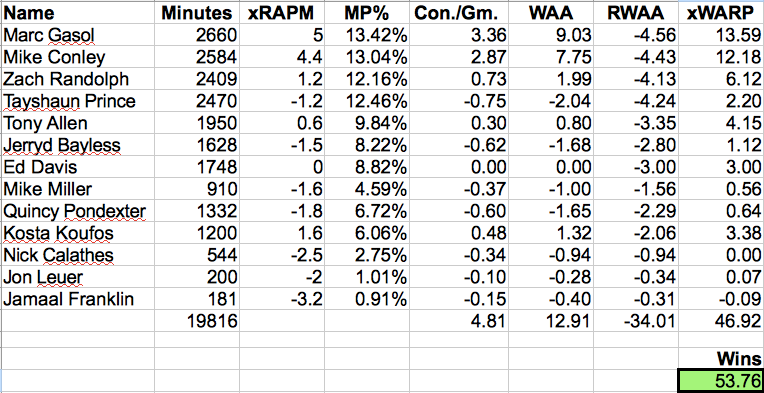
Unlike yesterday when looking at the Knicks, today’s post looks at a team that actually has a chance at winning a championship, the Memphis Grizzlies. The Grizzlies have a tough road to a title, given how stacked the top of the Western Conference is but they have the talent to make a run. Last year, Memphis won 56 games in the stacked West, and this offseason, they added Mike Miller and his three point shooting to the mix, a much needed skill for a team that often struggles to find efficient offense. So what do Nathan Walker’s projected xRAPM numbers and my minutes projections suggest that the Grizzlies will do next year?

Memphis projects to win 54 games via this method. Why, given that they won 56 games last year and added a solid player, with a needed skill in Miller, do they project to win fewer games? Well, regression to the mean mostly. Mike Conley was absolutely incredible last year as a two way performer by xRAPM, posting a +3.05 on offense and a +2.04 on defense. This leap forward for Conley last season was well above anything he had previously done, and statistically speaking, it’s likely that he regresses a bit to something closer to his prior levels of performance. Marc Gasol projects to regress a bit, too, from his +6 xRAPM to a still excellent +5 next year. Zach Randolph figures to suffer a bit of age related decline. Ed Davis should improve, though, and that should mitigate some of the expected drop in Z-Bo’s productivity. All in all, Memphis projects to be a very tough team yet again next year and they could easily emerge from the Western Conference to compete in the Finals.

One thing to note is that the Grizzlies could potentially be much better or worse than this projection depending on how good a coach Dave Joerger turns out to be and whether he’s able to make better use of the team’s talents than Lionel Hollins did. If Joerger were able to maximize the talents of his players and minimize their flaws, their per minute productivity (as measured by xRAPM) could see an overall boost. I think Hollins is a fine coach, but Joerger has been truly excellent in his previous head coaching stints (he’s one of the most successful minor league basketball coaches ever), so there’s some possibility that Joerger could help the Grizzlies reach new heights. On the other hand, Joerger is a rookie at the NBA head coaching level and his education at this level could leave the Grizzlies a bit short of their potential. Given his prior success, I’d bet on Joerger to do well, but only time will tell.

Image from seandavis via Flickr.

Projecting the NBA Using xWARP: New York Knicks

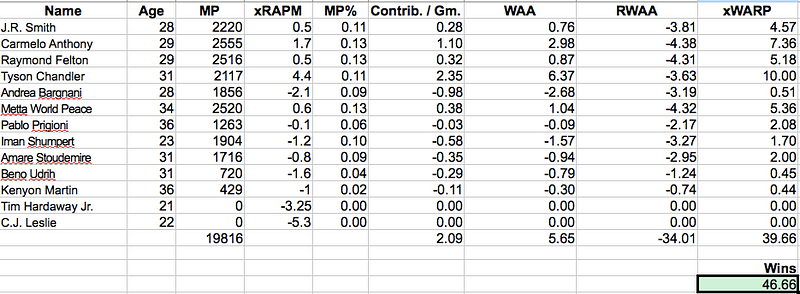
The Knicks are not contenders. Let’s get that out of the way to start. This core group of players won 54 games last year, but they did so on the strength of two runs of, frankly, unsustainable three point shooting as a team. According to NBAWOWY, in the first 23 games of the season, in which the Knicks went 18–5, New York shot 41% from deep on 29.4 attempts per game. Later in the year, the Knicks got similarly hot from long distance, shooting 40.6% from three on 28.2 attempts per game. For the season, the Knicks were 37.6% from three on 28.9 attempts per game. So, in games outside of those first 23 and the last 18, the Knicks shot a mediocre 34.4%. For the Knicks to have shot that well as a team, for that long during those runs is frankly remarkable, but it’s pretty unlikely to happen again. It’s especially unlikely to happen again next year, as the Knicks will be without their best three point shooter from last year, Steve Novak, and will have Andrea Bargnani’s below average three point stroke in his stead.

Additionally, Jason Kidd retired and will now be coaching the Nets across town. Beno Udrih is a solid replacement, but he’s no Jason Kidd. Even at 39 years old, Kidd was a +1.4 in xRAPM, on the strength of his very strong defensive contributions at the point guard position. Udrih is solidly above replacement level, but projects as just a -1.6 by xRAPM for next year in Nathan Walker’s numbers. Finally, many of the most important Knicks project to regress a bit. Tyson Chandler projects to have a big step back from last year, owing both to his age and expected regression to the mean. Chandler was better last year than he has traditionally been by xRAPM, clocking in at +5.3, when he is usually in the mid +4 range. Carmelo Anthony projects at +1.7 xRAPM, down from +2.3 this past season- again likely the result of regression to Carmelo’s historical mean level of performance. Pablo Prigioni is also quite old and is thus projected to decline from last year’s solid performance to something more average. Adding it all up, with the minutes projections, we get:

The Knicks project to win 47 games next year, down from 54 this past year. This is right in line with the ESPN Forecast of 48 wins for the Knicks. In fact, a lot of the projections so far seem to line up fairly well with the ESPN Forecasts, which have proven to be pretty accurate over the years. That makes me feel more confident about this exercise. One item of note: in both the East and West, my projections are higher on the teams ESPN has projected to place 4th in their conference. I have the Nets and Rockets both placing second in the East and West, respectively. It’s probably the case that the ESPN Forecast voters were factoring in some amount of an adjustment period for both these two teams, as they have both undergone a fair bit of roster turnover, which can cause teams that look great on paper to fail to live up to wins expectations sometimes. It will be interesting to see if it turns out that these xRAPM projections overrated these teams or if the ESPN voters were sleeping on them. I can’t wait to find out. Next up: the Memphis Grizzlies.

Image from Keith Allison via Flickr.
New Projection Recipe

My work projecting the NBA using xRAPM has lead to some interesting conversations with readers and other interested NBA fans. It also lead to further discussion with Nathan Walker over of The Basketball Distribution, who was the person who inspired me to start doing these projections in the first place. Through an e-mail exchange, he provided me with a method, using the age and prior year xRAPM of the player in question, which projects xRAPM for the next year very well. The R² is .74. Given that this method seems much more scientific and how startlingly good the results are at predicting future performance based on such simple inputs, I will be re-running my projections for the 8 teams that I’ve already done and then continuing on using the method Nathan provided going forward. The minutes projections will still be done using the Kupfer method described previously here. I plan to try to bang out the remainder of the projections within the next few weeks and then adjust based on strength of schedule and HCA at the end of the process and right before the season gets underway to try and have the best possible projections for you. Basically, we’ve got a brand new recipe and it’s time to get cookin’.

Oh and go follow Nathan on Twitter, since he’s awesome and helped me do a better job than what I was doing.

Image from Timsnell via Flickr