
Projecting the NBA using xWARP: Chicago Bulls

I really like advanced basketball stats and trying to learn as much as I can about them. As a result, I spend an inordinate amount of time perusing the threads over on the Association for Professional Basketball Research (APBR) message board. Through my reading there and elsewhere (usually following links I found there), I have come into contact with a statistic called regularized adjusted plus-minus or RAPM for short.

Adjusted plus-minus is essentially an approach that attempts to use on / off data to determine how much a given player contributes to the margin of victory (or loss as the case may be). It does this through regressions on lineup data found in play-by-plays to determine the +/- of a given lineup over a given shift that they were out there. The regressions then spit out numbers which show how much a player is likely worth + or — per 100 possessions. The problem with adjusted plus-minus in its regular form is that is quite noisy and that there are collinearity issues. Collinearity, in this context, just means that there are often players who play together a lot and thus it is hard to disentangle their value in +/- from one another. Additionally, the sample sizes of minutes played by each lineup are small, which leads to the aforementioned noisiness in the data.

RAPM improves upon the regression-based approach of standard adjusted plus-minus by using a technique called regularization or ridge regression. It’s basically a high level math technique that statisticians use to deal with the problems presented by the normal adjusted plus-minus type of regressions. It leads to much less noisy, more accurate results.

Finally, xRAPM, the subject of this post, includes a box-score based statistical prior to further inform the player ratings and thus improve the predictive effectiveness of the metric. All of this is a long-winded way of saying that xRAPM is the most accurate +/- metric that exists for predicting future results of which I’m currently aware. As a result, it’s the method that I will use to project each of the 30 teams’ records in the NBA next year, based on estimated minutes, and impact of the players on each team. The numbers for xRAPM are available here. (Thanks to Jeremias Engelmann for publicly providing the data).

xRAPM is a great tool for projecting, but I wanted to translate it to something more tangible to the common fan. Wins. After talking to Nathan Walker of the Basketball Distribution on Twitter, I learned a way to convert xRAPM into WARP (wins above replacement player). In short, xWARP (for short) examines the number of wins a player contributed over what an available replacement would provide in the same number of minutes. I set replacement level at a xRAPM of -2.5 points per 100 possessions in xRAPM. Nathan uses -3.5, according to our Twitter conversation, but the end result of projecting is the same.

Now, for the true purpose of this post. I will be examining every team in the league by looking at their xWARP for this past season and trying to project their xWARP following their offseason moves. I’m starting with the Central Division and the Chicago Bulls, because they’re my favorite team, I know them best (and can best guess minutes distributions), and because their offseason is more or less done (save a cheap big man or guard signing, which are likely to be replacement level players themselves, so have basically no impact on this math).

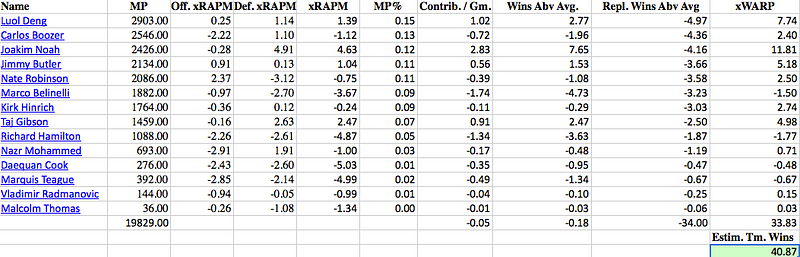
The Bulls this year were a team that outperformed their point margin by about 3 wins. Their MOV was a relatively small +.32. Subbing that into the standard MOV to wins converter equation from The City’s Advanced Stats Primer ( 2.54*MOV+41 = wins), the Bulls should have won about 41.8 games, so basically 42 wins. Instead, the Bulls were statistically lucky. They won 3 more games above their expected win total. A lot of that probably had to do with Marco Belinelli’s 3 ridiculous game winners. But basically, the Bulls were better than expected based on how close they played their opponents. This was not a 45 win team, it was more like a 42 win team. Here are the numbers:
image

By xWARP the Bulls look more like a 41 win team but the point is roughly the same. They overperformed their expected win performance level based on what amounts statistically to luck.

So the Bulls just signed Mike Dunleavy Jr this year, a good player, and they get their MVP, Derrick Rose back, so surely they will win many more games this year, right? Short answer: yes. But let’s look at the numbers.

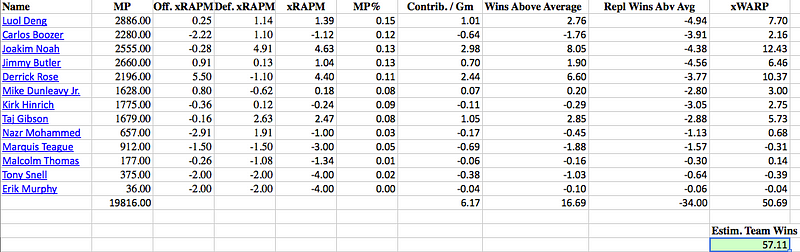
I projected the Bulls’ minutes distribution for next year using a combination of a method described here by Kevin Pelton formerly of Basketball Prospectus and currently of ESPN.com Insider, based on a study by basketball statistician Ed Kupfer and my own intuition about how many minutes a player would play per game played based on rotations. Pelton describes the method as setting the expectation for a player starting at 76 games and going down about one game for each six missed the previous season and one for each 20 missed two years ago. Two years ago was a 66 game season, so I used 16 games instead of 20 games when calculating that number of games in the projection. I did two projections. I projected what the Bulls would look like with Derrick Rose playing just 61 out of 82 games (the number according to the Pelton-Kupfer projections) at his usual 36 minutes a game. Then I looked at what they would look like if Rose matched his career high in minutes played of 3026 minutes (a/k/a the scenario where he’s truly 110% in Rose-speak). In the latter scenario, I subtracted Rose’s additional minutes from Kirk Hinrich and Marquis Teague, the back-up point-guards. Here are the results for the less optimistic, (probably) more realistic numbers for Rose playing about 2200 minutes over the season:
image

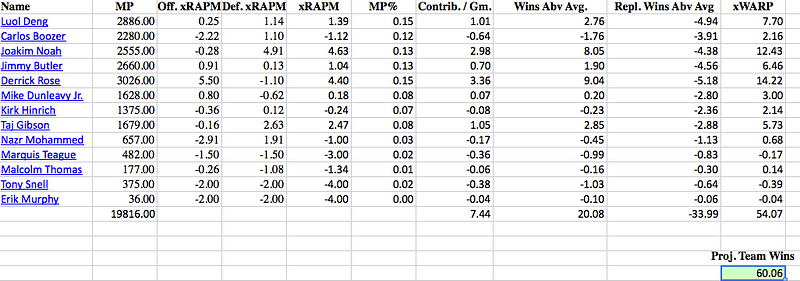
The Bulls here project as … a 57 win team. After not having their MVP for an entire year and winning 45 games (and really being more like a 41–42 win team) a 57 win season with him playing nearly 2200 minutes would be great for Bulls fans and should signal return to the East’s top tier. What about if the Bulls get 110% super-healthy Derrick Rose and he plays 3026 minutes?
image

Congratulations Bulls fans! With a very healthy Rose, you’re looking at … a 60 win team! Adding about 800 minutes to Rose’s minutes projection yields an additional 3 wins in xRAPM. Basically, if DRose is back to the level that his old self and able to play 2010–11 level minutes, then the Bulls will look very much like the team that won 62 games that year and 50 out of 66 the following year. Even if Rose is only able to go 61 out of 82 games, the Bulls still look to be a high 50 win team. Of course, there are caveats, in all of this. Luol Deng and Carlos Boozer have both been declining by xRAPM for 3 years in a row. They may further decline. Rose may not be at the level that he was before his injury right away. There could be another major injury to a significant piece of the core group (*fingers crossed, knocking on wood that this doesn’t happen*).

But there are potentialities that would allow the Bulls to look even better. Jimmy Butler improved quite a bit over his rookie xRAPM of -.7 to a solid 1.04 this past year and he’s young enough he should continue to improve. Joakim Noah is still just 28 years old and is in his peak years, so he will likely remain the same or slightly better. Marquis Teague may improve more than I have estimated (I assumed he would be at least a -3 in xRAPM this year, slightly below replacement level still but not as bad as his terribad previous season xRAPM of nearly -5). The new rookies may be better than the -4 xRAPM level that I have pegged them at, just to be safe, and may get more minutes if they outplay the older players, though with Thibs at the helm, I highly doubt the rookies get many minutes, as is clear from my minutes projections. Finally, Derrick Rose may be better than ever. He was on a solid upward trajectory prior to his injury and he’s had a long, long time to improve on his jump shot and other skills. He’s been able to observe and watch for defensive tendencies. Now he’s coming back after taking his time with his recovery and feels 100% right. I’m certainly not going to rule out him possibly ratcheting up another level. I’ve learned not to doubt the man.

After all that dense reading, I leave you with a whole bunch of awesome DRose highlights:

Image from Keith Allison via Flickr
It’s Not About Money, It’s About Sending a Message: Mikhail Prokhorov’s Money Torching Quest for an NBA Championship

Mikhail Prokhorov has clearly shown that he doesn’t care one iota about spending money as an NBA owner. In the time since he purchased the Nets franchise, he has traded for the albatross contracts of Gerald Wallace and Joe Johnson, then earlier this summer he added Paul Pierce, Kevin Garnett, and Jason Terry for basically a bunch of draft picks and useless players. Yesterday came word that the Nets have convinced stat-stuffing swingman and defensive savant Andrei Kirilenko to sign for merely $3.1 million a year, using the luxury taxpayer’s mini midlevel exception, after he earlier opted out of a $10 million final year with the Minnesota Timberwolves. As a result of the signing, the Nets’ owner will be paying over $186 million for the Nets roster for JUST THIS YEAR. (h/t: Devin @ TheBrooklynGame for the figures.)

As noted above, the Nets have been no stranger to spending since Prokhorov took over, but this is something else entirely. With this summer’s moves, the Proker is showing the rest of the league that money simply does not matter to him at all. He’s become the NBA’s rogue, chaotic force, hell bent on sending a message that he will build a winner, no matter the cost.

The Nets now have a starting five featuring 2 future Hall of Famers and rounded out with All Stars at every other position. Their bench now looks similarly stacked. There’s backcourt scoring and floor stretching in Jason Terry. Kirilenko’s great defense and all around solid play everywhere else. Reggie Evans’s ability to hit the glass. Andray Blatche’s post scoring and occasionally solid defense. Plus, capable point guard play holding it all together from Shaun Livingston. The whole bench has roles that fit together reasonably well with solid contributors.

The Nets have built a deep roster that should allow them to rest the old dudes from Boston and keep them fresh for what should be a deep playoff run. If Jason Kidd proves up to the task of managing the egos and crafting an offense that emphasizes ball movement, as he’s promised, the Nets could be incredibly dangerous. It’s all because Mikhail Prokhorov is determined to show the rest of the NBA that this league deserves a better class of owner and he’s gonna give it to them.

The Cavs make a smart bet on Andrew Bynum

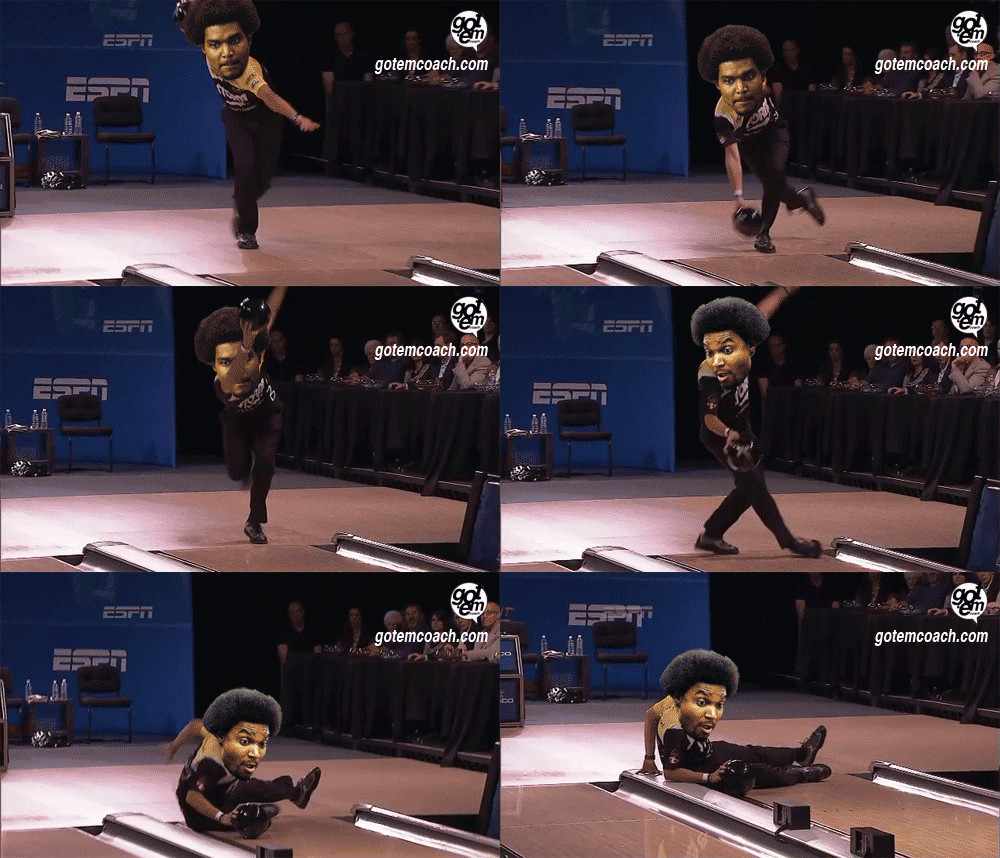
The Cavs have reportedly signed Andrew Bynum, the much maligned center formerly of the Los Angeles Lakers and the Philadelphia 76ers… sort of. Bynum never actually played a minute for the Sixers, spending much of the year alternating between being injured and angering the good people of Philadelphia by bowling, despite his fragile knees, suffering a setback in his knee rehab in the process.

via gotemcoach.com

Going into the offseason, there was a lot of curiosity over what would be the market for Bynum’s services. The Sixers quickly took themselves out of that market, through their draft day acquisition of Nerlens Noel and a top-3 protected 2014 first round pick in exchange for All-Star point guard, Jrue Holiday. With that maneuver, Sixers’ GM Sam Hinkie signaled that he was committing to a rebuilding season and that Nerlens Noel would be his center of the future.

It quickly became clear that only three teams were really pursuing Bynum- the Cleveland Cavaliers, the Atlanta Hawks, and the Dallas Mavericks. As it turned out, the market for Bynum was pretty dry. The Cavaliers made the best offer, and from Bynum’s perspective, it’s not even that great an offer. Bynum’s deal will potentially pay him $12 million per season for 2 seasons, but he has to reach performance incentives, including a minimum numbers of games played in the first season. The second season is a team option. All told, Bynum is only guaranteed $6 million in this deal. This is basically a no brainer for the Cavaliers. The contract incentives Bynum must reach to get his money provide him a reason to care, to show up, and to not spend his time bowling instead of rehabbing. An engaged Andrew Bynum is a very, very good player. He’s arguably the second best center in the league, behind only Dwight Howard, when he’s on it. The trouble is his health and his attitude. This deal protects the Cavaliers from both of those potential downsides.

As far as things on the court go, the Cavs have built a neat team around star point guard, Kyrie Irving. They have a floor stretching power forward in the recently drafted Anthony Bennett. They have two very good big men, when healthy, in Anderson Varejao and now Bynum. They have backcourt scoring in bunches in Irving and promising shooting guard, Dion Waiters. Additionally, they added veteran guard and third place finisher for this year’s Sixth Man of the Year, Jarrett Jack. On the wing, they signed Earl Clark, who could intrigue if he builds off of a solid season of improvement last year. Head coach Mike Brown will get this group to defend better than last year, and now with Bynum, Brown has a very good rim protector to pair with Varejao’s active all-around defensive efforts. This is a team that should compete for a playoff spot, if things go right. Bynum will have a lot to say about that. Here’s hoping he takes advantage of this opportunity and reminds everyone of how good he can be when he’s right mentally and physically.

Feature image from Keith Allison via Flickr

For some reason, the Detroit Pistons have signed Josh Smith

Get used to this, Detroit fans

Josh Smith agreed to a 4 year, $56 million deal with the Detroit Pistons yesterday. For the life of me, I can’t figure out why Detroit would make this move. Smith is a pretty good, sometimes really good player but he doesn’t really fit with the Pistons current roster, at all.

Detroit’s best two players last year were young big men, Andre Drummond and Greg Monroe.  The reports of the deal suggest that Smith will likely start alongside those two players, with guards Brandon Knight and the recently drafted Kentavious-Caldwell Pope rounding out the Pistons’ starting unit. Drummond and Greg Monroe are both players who want to operate close to the basket, and Josh Smith, when he’s at his best, is a player who operates near the basket. Josh’s problem, and the biggest problem with this signing, is that Josh Smith does not love to operate near the basket. What Josh Smith really loves are jump shots. But sadly for Josh, jump shots do not love him back. Josh fancies himself more of a swing man than his size and skill-set would suggest is wise.

Unfortunately for the Pistons, and fans who would like to see J-Smoove reach his peak effectiveness, playing Smith alongside Monroe and Drummond will do nothing to dissuade him from floating more and more around the perimeter, likely tempting him to take more and more of the jumpers that, try as he might, Josh just can’t make. In a vacuum, Smith is worth right around what the Pistons have committed to him over the next 4 years. But Smith will not be playing in a vacuum, he will be playing with Monroe and Drummond and barring a, likely unwise, trade of one of their young, promising, cheap (!) big men, the Pistons figure to have serious spacing issues for their foreseeable future. Piston’s President of Basketball Operations, Joe Dumars has created a mess for himself when there were likely much more prudent options available. He’s improved the overall talent of his club, there’s no doubting that, but it’s hard to see how that translates to winning more games when the talent now fits together so poorly. It could be that Dumars just believes in grabbing talent when it’s available for a team that was so bad last season, but I can’t help but thinking patience should have won the day here. Ah well. As a Bulls loyalist I say, you take those jumpers, Josh Smith. You take them as much as your heart desires.

The Houston Rockets have won the Dwight Howard Sweepstakes

This about sums it up, really.

Kudos to Houston Rockets General Manager, Daryl Morey. He got his second superstar to pair with James Harden. After years of hovering around Western Conference mediocrity, the Rockets now have two of the best players in the league 27 years old or under. Dwight Howard is, unquestionably, the best center in the NBA and James Harden is, probably, the best shooting guard currently operating in the league (apologies to Dwyane Wade and Kobe Bryant, whose respective runs at the top of the position have passed). In addition to simply being two incredible talents at their respective positions, Harden and Howard have synergistic skillsets. Howard is one of the league’s absolute best and most dangerous fingers as the roll-man in the pick and roll and James Harden is one of the best guards in the league at running the pick and roll. There’s a potential for so, so many Harden to Dwight lobs for easy dunks, you guys. It’s going to be so fun.

There’s still loads of work to be done filling out the remainder of the roster. Current center Omer Asik has requested a trade, as he’s too good to be a backup, even for Dwight Howard, and the Rockets need to move his salary to have the space to pay Dwight what they’ve offered him. They will also likely move Jeremy Lin, as Patrick Beverly has proven to be his better at the point guard position for a small fraction of Lin’s salary. There are rumors that the Rockets may try to sign and trade for Josh Smith, using one or both of the Lin and Asik contracts, or possibly trade Asik for stretch power forward Ryan Anderson, a former teammate of Howard’s from Orlando. It will be interesting to watch how Morey is able to round out this roster to maximize its chances at winning it all, but the heaviest lifting is done. Dwight Howard is a Rocket. Daryl Morey’s long chase for a true top 5 player is over.

Kudos, also, to Dwight for choosing the best fit for his talents and his best chance at winning a title, all while sacrificing $30 million in guaranteed money, which is HUGE given his back surgeries. As Dwight reportedly said, he’s betting $30 million that the Rockets will be better positioned than the Lakers going forward to win a ring. Now that Dwight’s wearing the Rocket uniform and not the Purple and Gold, it’s probably a pretty safe bet.

James never has to worry about this again

Andre Iguodala is a Warrior, at a future cost

Dre doing what Dre does

Andre Iguodala, unofficially, became a Golden State Warrior today, when he agreed to a 4 year, $48 million deal with the Bay Area club. In order to sign Iguodala, the Warriors had to dump the sizable contracts of Richard Jefferson and Andris Biedrins, as well as Brandon Rush on the Utah Jazz.

In exchange for accepting those bloated contracts attached to relatively useless players, the Jazz extracted the price of a 2014 first rounder, a 2017 first rounder and multiple second round picks. The 2014 pick should be relatively late in the first round, as it is almost a certainty that the Warriors will be improved from the 6 seed they were this year with Iguodala in the fold. The location of the 2017 pick is much less certain as the only players on the Warriors’ books for that season are Stephen Curry and now Iguodala. This is the move of a team very much taking its chances at a Finals run this season. Iguodala is 29 years old and a player who relies heavily on his athletic gifts as the keys to his effectiveness. He’s not a terribly skilled player in the sense that he has tremendous offensive footwork or a reliable jump shot. He’s explosive and gets to the basket and can handle the ball fairly well. He’s also a very smart defensive player and knows what to do against just about anyone he’s matched against. He does, however, use his athleticism on the defensive side of the court quite a bit, as well.

As I’ve mentioned before, wing players (particularly the ones who are explosive athletes like Iguodala) tend to decline rather quickly after they hit 30 years old.  It’s worth considering that they have just committed $12 million a season for 4 years to a wing player who turns 30 next season. The salary is quite a bit and worth worrying over by itself but when combined with the picks surrendered to clear the cap space to sign Iguodala, this has the potential to be a bad overall transaction for the Warriors should they fail to win big in the next few years. More optimistically, the Warriors should be much improved for next season, which is really what this move is all about. With Iguodala and Klay Thompson manning the starting wing positions, Stephen Curry should be much more easily protected on defense so that he can go absolutely NOVA more often, like he did so often in the playoffs.  You remember, like this:

If the Dubs are able to improve on their second round ouster from last year and maybe even make a run all the way to the NBA Finals, this move will seem much more worth it. With the Clippers and Rockets also improving markedly it will be interesting to see if the Warriors can pull it off. At the very least, they have struck a significant blow to the Denver Nuggets, taking their best player for nothing at all in return. That has to be a bitter pill for Nuggets fans, especially after already watching these same Warriors defeat them in the first round of the playoffs.

Tyreke Evans got paid but will he be overpaid?

Tyreke is really good at this

The New Orleans Hornets Pelicans got their man on Thursday by completing a three team trade with the Sacramento Kings and Portland Trailblazers. The Pelicans agreed to pay Tyreke Evans $44 million over 4 years, the Kings received combo guard Greivis Vasquez from the Pelicans to help facilitate the sign and trade plus a second round pick from the Blazers, and the Blazers got center Robin Lopez in exchange for the newly drafted, Jeff Withey.

Evans is a player who showed enormous promise in his first year, winning the rookie of the year award, dropping a very good (for a rookie) 18+ Player Efficiency Rating. The problem for Evans, and now for the Pelicans, is that Evans hasn’t gotten any better, really, since that rookie season. He got worse for two years following his rookie year before bouncing back this year where he was marginally better than his rookie year. Players this young and this talented shouldn’t stagnate for 3 full years but that is just what Evans has done. This deal feels like it could be a pretty big overpay, but Tyreke Evans has consistently shown the rare ability to get wherever he pleases on the basketball court, along with solid passing and rebounding for a wing player. He’s still a below average shooter and his defense is poor. If his shooting continues to improve, as it did this year, and if he can figure things out defensively, this will seem like a good, maybe even great deal. Looking at it without the benefit of knowing the future, it feels like a reach. The Pelicans are betting on Evans’s talent and their own coaching staff’s ability to get the most out of him, and it’s hard to totally blame them. After his first year in the league, Evans looked like a sure bet to be a candidate for a maximum contract extension. If he lives up to that promise in New Orleans, this deal will go from looking like a reach to an absolute steal. That’s the way these things go sometimes. Just ask people who bashed Mike Conley’s extension or questioned the Warriors for locking up Stephen Curry when concerns about his weak ankles were rampant. Conley now seems appropriately paid and Curry is, rightly, perceived to be an absolutely incredible value as a borderline superstar level player working on a contract several million a year below the maximum he could be paid. Evans will be just 24 next season and if you’re going to risk overpaying a player based on projected growth, betting on a player who will be just 24 in the first year of a 4 year deal is one of the best bets you can make, especially when it is already clear, as is the case with Tyreke, that the talent is there.

The Kings, under newer, much more competent management, have done well for themselves here. Once it became clear that New Orleans was going to pay much more for Evans than his production the last few years would suggest is wise, and the Kings knew they were uncomfortable making the bet that Evans lives up to his potential, getting assets in return for losing him became paramount. That’s just what the Kings have managed. Greivis Vasquez is a solid offensive player, who doesn’t really have the physical tools to be a plus defender. Vasquez has improved every year he’s been in the league and stands to make just a bit over $2 million next year. He’s a nice value to go with the second round pick the Kings picked up in the deal from the Blazers.

The Blazers got Robin Lopez as a defensively focused center to pair with their star power forward LaMarcus Aldridge. Lopez is also an efficient scorer on an average usage level, so he is not a negative on the offensive end by any means. He should be a very good fit with Aldridge, and the Blazers must hope his presence will help convince LMA to stop demanding trades to my beloved Bulls.

The Timberwolves add shooting, likely at a cost to their defense

New Timberwolf, Kevin Martin

The Minnesota Timberwolves agreed to terms with free agents, Kevin Martin and Chase Budinger, the latter of whom spent this year as a member of the ‘Wolves squad. Budinger’s deal runs 3 years, for a total of $16 million, according to, who else, Woj. Martin, for his part, agreed to a deal for 4 years, $28 million. The Wolves were clearly interested in fixing on of the team’s biggest problem areas on the offensive end last near, namely that they had very little ability to stretch the floor or shoot beyond the arc. They were dead last in 3 point shooting percentage at a pitiful 30.5% as a team and were 28th of 30 teams in 3 pointers made.

Budinger struggled with injury this past season and only managed to play and his absence surely didn’t help the Wolves’ lack of shooting. In addition, when Budinger was on the floor he shot just 32% from three, likely, again, owing to his injury woes. The Wolves are betting that Budinger will be closer to the high volume, medium efficiency 3 point shooter that he’s been for most of his career, as a career 36% three point shooter on 5.9 threes attempted per 36 minutes. A deal that sees Budinger making basically a smidge above the league’s average salary for 3 years, given his status as a league average wing (in just about every way), feels like the right value, especially given the salary bump that shooters, rightly, receive for their floor spacing value which goes even beyond their box-score contributions. The Wolves may have been wise to make this deal a bit longer, given how young Budinger is, and his room for improvement, as he gets set to enter his prime years. All in all, this deal is a good one and it seems obvious that the Wolves did well to retain Budinger at a solid price.

Less obvious is the merit of signing a 30 year old Kevin Martin for a 4 year deal that will pay him an average of $7 million a year. Martin is a hyper-efficient guard who can shoot the lights out, and as mentioned above, the Wolves really need the shooting and floor spacing that Martin has provided for his whole career. There’s reason for worry here, though. Thirty years old tends to be the point at which many shooting guards, historically, have begun to decline.  Often, that decline is precipitous. Martin has never been a superstar. He has been an above average player whose ability to score many points without taking many shots has managed to balance out his, frankly, terrible defense. If Martin’s offensive ability declines as he ages, he could easily become a liability to have on the floor. Paying $7 million a year for a player who could become a liability on the back half of his newly signed contract is obviously not great. Unfortunately, Martin has already shown what may be indicators of athletic decline. He’s getting to the line much less frequently than he once did. In his seasons four seasons from age 24 to 27, he averaged well over 9 free throw attempts per 36 minutes three times and the one season he didn’t he still got to the line for a healthy 7.5 attempts per 36. Over his last two seasons, Martin has averaged 5.1 and 4.1 FTAs per 36 minutes, respectively. Last season, Martin was able to counteract that lack of attempts at the line to retain his normal hyper-efficiency by simply making even more shots per attempt than normal, shooting 45% from the floor and 42.6% from three, topping his career averages of 44.3% and 38.5% respectively. It should be noted, though, that Martin likely shot so much better due to the quality of looks he was getting playing alongside two of the league’s very best players in Russell Westbrook and Kevin Durant. His looks are unlikely to be quite so open in Minnesota. The Wolves front office has to hope that Martin can buck the historical trend and the trend he himself appears to be on by relying even more heavily on his highly effective, highly ugly looking three point shot. If the years on Budinger and Martin’s contracts were reversed, these would be pretty perfect deals for Minnesota. For this year, though, the Wolves appear to have done much to fix their absolute biggest weakness on offense.

Unfortunately, in order to pull the move to sign Martin, it appears the Wolves will be sacrificing one of last year’s team’s relative strengths. The Wolves were 13th last year in Defensive Efficiency, just above average. One of the biggest reasons for the Wolves relative strength on defense was the presence of veteran swingman and current free agent, Andrei Kirilenko. Given the money Minnesota has just doled out to Martin, along with a likely extension for restricted free agent big man and Superman villain Nikola Pekovic, it appears unlikely Kirlienko will be back with next year’s team. Two steps forward, for one step back, it appears for Minnesota President of Basketball Operations, Flip Saunders, this offseason. It will be interesting to see if Coach Rick Adelman can get this squad to defend, despite a lack of obvious stoppers. On point rotations with very few, if any mistakes will be what’s required. Time will tell if these Wolves are up to the task.

Clippers become scarier through blockbuster trade, Suns rebuild, again

Oddly, J.J. Redick and I have the same facial hair pattern

The Los Angeles Clippers, yes those Los Angeles Clippers, have had perhaps the NBA’s best offseason thus far. The Clippers landed on the league’s top coaches by prying Doc Rivers from the Celtics (a massive upgrade from the “coaching” provided last year by Vinny Del Negro) and reached an agreement on a maximum contract extension with one of the league’s very best players, point guard Chris Paul. Today, they gave Doc more talent to shape and CP3 a better supporting cast with which to work. In a blockbuster three team deal, the Clippers agreed to trade promising guard, Eric Bledsoe and aging small forward Caron Butler to the Phoenix Suns in exchange for 3 and D swingman Jared Dudley, while simultaneously sending a second round pick to the Milwaukee Bucks in a sign and trade for shooting guard J.J. Redick. The Bucks will also receive a second round pick from the Suns for their trouble.*

Redick’s new deal is reportedly for 4 years, $27 million, which feels right for a floor-spacing shooting guard who does a little bit of everything while shooting very well from deep (39% for his career). Redick’s numbers did slip overall last year, but it was primarily due to the pretty miserable situation in Milwaukee into which he was traded. J.J. Redick things are meant to be done for a smart team with smart teammates, and well, Brandon Jennings and Monta Ellis are not smart basketball players. They make lots of bad decisions and take bad shots and waste opportunities created by the off-ball movement of a player like Redick. That should change in L.A. where Redick will be playing for a great coach and with one of the league’s smartest players in CP3, Redick should see many more open looks and should really shine for the Clippers. It is worth noting, though, that Redick’s production did slip this year, as he will be 29 in the first year of this new deal and many a shooting guard has seen his production slip starting at around age 30. Should Redick follow that path, the numbers on this deal might end up seeming a bit bloated, but for a team that is clearly all in and going for it with superstar Chris Paul, this is a minor worry. In addition to shoring up the shooting guard position, the Clippers are getting an upgrade at small forward swapping out the declining 34 year old Caron Butler for career 40.5% 3 point shooter and solid defender, Jared Dudley. Dudley doesn’t have the ball-handling or penetration skills of Butler, but he’s younger, on a very friendly deal, and will be a great offensive fit with CP3 dribble drives and pick-and-roll dives to rim by DeAndre Jordan and Blake Griffin resulting in the collapse of the opposing team’s defense inside freeing Dudley for open looks in the corners. This trade is a big win for the Clips.

For the Suns, the deal is an opportunity to rebuild, yet again. This time they’re betting on Eric Bledsoe to be a star. Bledsoe has certainly shown flashes that he could be that guy. Bledsoe is an athletic freak, who can do things like this:

Goodness

And perhaps more impressively, he did this to Dwyane Wade:

Get that out outta here. Gif via SBNation.com.

Phoenix, and its new GM Ryan McDonough, are hoping that Bledsoe can develop into the next Russell Westbrook: an incredible athlete who is a terror on both ends with whom opposing point guards must deal. At just 23 years old, Bledsoe has shown improvement in leaps and bounds and this year posted a solid 17+ PER while also becoming a terror on the defensive end. The Clippers were nearly 5 points per 100 possessions better on defense with Bledsoe on the floor versus when he sat, which is doubly impressive when you realize that the player he was usually replacing was CP3, who made the NBA’s All-Defensive Team this year. This is a smart move by the Suns, as they sacrificed relatively little (Jared Dudley’s talents are mostly wasted on a bad team like the Suns and taking on Caron Butler’s deal is not that onerous) in order to acquire a guy who has the potential to be an impact player on both ends of the court. Bledsoe is the sort of talent you bet on. Good job by Mr. McDonough.

*The Bucks have to be disappointed to receive just two second round picks for Redick after giving up promising rookie combo-forward Tobias Harris to acquire Redick for just the back half of this past season, especially given how well Harris played in Orlando following the trade. On a brighter note, Redick was going to leave the Bucks either way so prying two second round picks out of the process is not nothing, but it probably feels pretty close to Bucks’ fans right now.

The San Antonio Spurs do a smart thing, lock up Tiago Splitter

In news that will surprise no one, the San Antonio Spurs just made a smart decision. The Spurs locked up free agent big man Tiago Splitter to a 4 year deal, worth $36 million, according to Adrian Wojnarowski. The big Brazilian won’t make many headlines or sell many jerseys, but what he does do is defend expertly, score quite efficiently, make the right pass almost always, and just generally make the Spurs better when he’s on the floor.

Splitter struggled a bit against the Heat in the finals due to the lack of a traditional big man for Splitter to match up with. Tiago, also rather famously, got obliterated at the rim by, the world’s best player, LeBron James. In case you forgot, it looked like this:

Yiiiikes. Gif via SBNation.com

What’s not immediately apparent from that quick look on the gif is that the reason LeBron is in position to crush Tiago so badly is that Kawhi Leonard was too close to the paint, allowing LeBron to protect the rim. Kawhi should have been in the corner, forcing LeBron to guard him. If Kawhi does his job, Tiago, having done everything right to this point, gets an easy dunk. Instead, Tiago ends up on the wrong end of a SportsCenter highlight. Poor guy. But this play shows you two things about Splitter. He knows where to be offensively and is unafraid of challenging shot-blockers at the rim with a strong finish. Against just about anyone else, save a LARRY SANDERS!, a healthy Dwight Howard, or in this case, an engaged LeBron freaking James, Splitter finishes that dunk through contact. That finishing ability and knowledge of where to be is a big reason why Splitter has a career True Shooting Percentage of 61% and sports a nifty 18.7 PER along with a pretty great .188 WS per 48 minutes. Splitter also will turn just 29 early this coming season and will be on a solid contract until he is 33. As a result, the Spurs can expect Splitter’s excellent production to continue relatively unabated for the duration of the deal. Just another solid, smart move from the team that makes them seemingly always.